
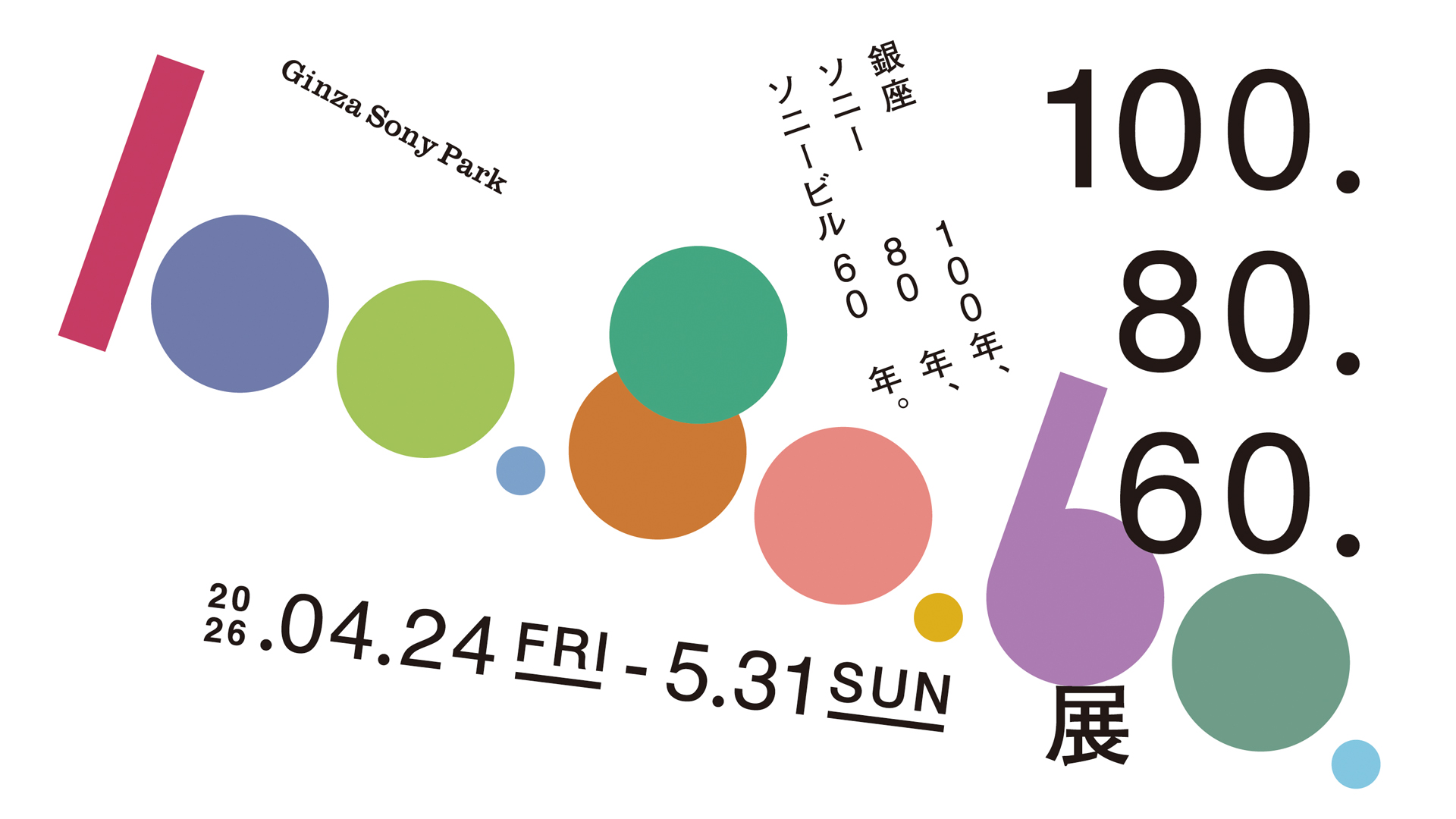
It will be held at Ginza Sony Park from April 24th, 2026 (Friday).
https://www.ginzasonypark.com/activity/022
To commemorate the 100th anniversary of the Showa era, which laid the foundation for modern Japan, Ginza Sony Park will hold the "100.80.60. Exhibition" (pronounced: Hyakuhachijuurokujuten) from April 24th (Fri) to May 31st (Sun), 2026. This program looks back on the passage of time under the theme of "Ginza 100 Years, Sony 80 Years, Sony Building 60 Years."
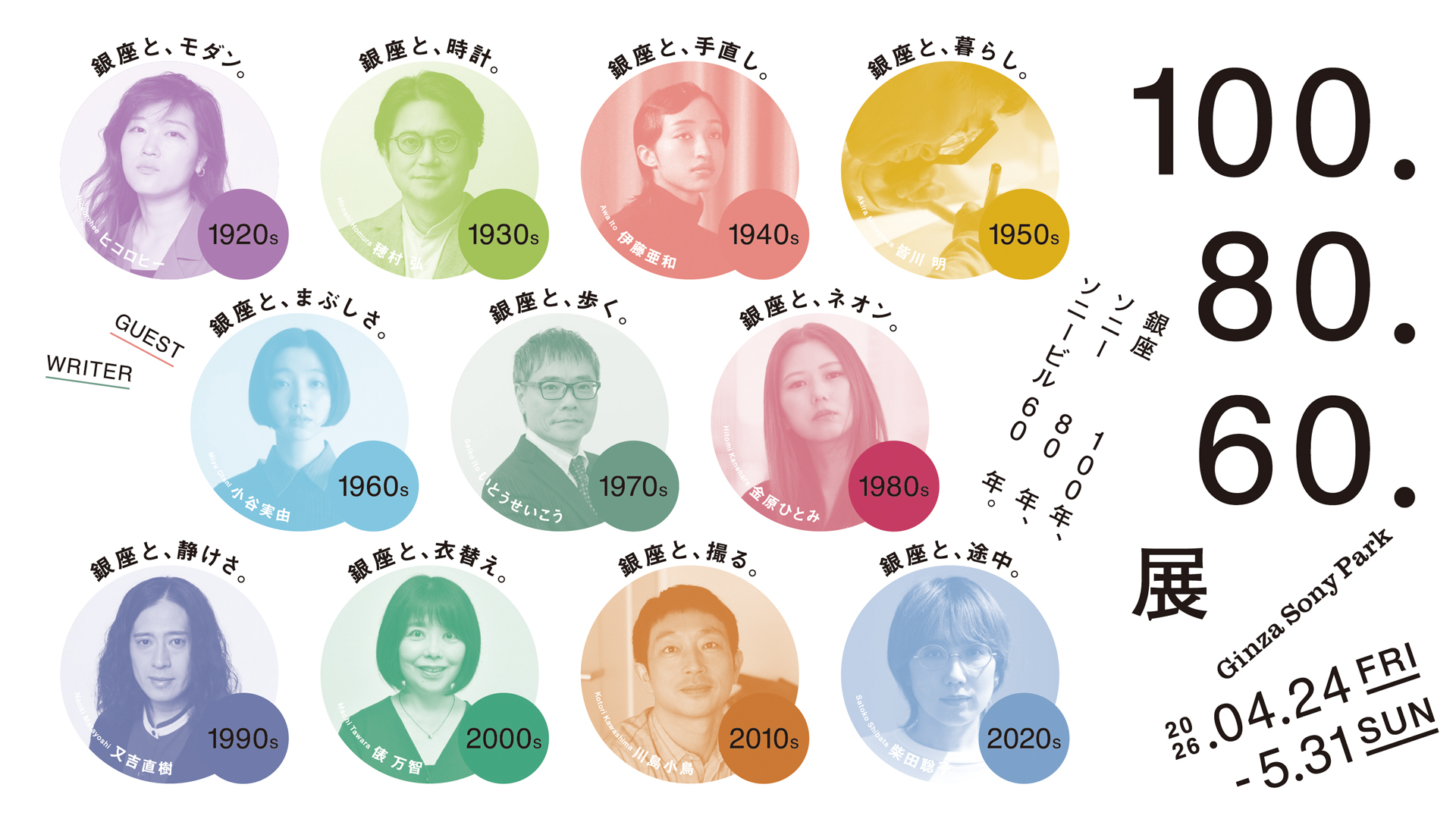
This program redefines the 100-year transformation of Ginza, a district that reflects the times, in 10-year increments, expressing the mood of each era with themes such as "Ginza and Modernity," "Ginza and Dazzling Light," and "Ginza and Changing Clothes." Based on these keywords, it will showcase essays, poems, and novels written by 11 unique writers and artists, including Hikohiro (comedian), Akira Minagawa (minä perhonen designer), Seiko Ito (writer/creator), Naoki Matayoshi (comedian/writer), Machi Tawara (poet), Kotori Kawashima (photographer), and Satoko Shibata (singer-songwriter/poet), in a three-dimensional exhibition. Furthermore, symbolic topics from Sony's 80th anniversary and the 60th anniversary of the opening of the Sony Building overlap with these 100 years of Ginza, creating a promenade-like space where the atmosphere of each era gently connects, allowing visitors to experience a unique historical stroll only available at Ginza Sony Park.
On the first basement floor, a portion of the book "Document of Ginza Sony Park Project," which records the thoughts and actions taken from the decision-making process leading up to the rebuilding of the Sony Building to its grand opening in 2025, will be on display. This will look back on the 60 years of this site, from the Sony Building which opened in 1966 to the current Ginza Sony Park, through which it has been inherited and evolved.
Furthermore, pre-orders for the book "Document of Ginza Sony Park Project" will begin at this exhibition corner, and a specially created model for this 60th anniversary, "Ginza Sony Park 1/300 built with LEGO® bricks" (created by LEGO® Certified Professional Builder Junpei Mitsui), will also be available for purchase.
In addition, during the "100.80.60. Exhibition," the Creative Center, the design division of Sony Group Corporation, will simultaneously host the first installment of its pop-up exhibition series "80. Your Story and Sony's Story" (pronounced: Hachijuten) in the blue tile gallery located in the connection between the second and first basement floors of Ginza Sony Park, commemorating Sony's 80th anniversary.
100.80.60. Exhibition: Ginza 100 years, Sony 80 years, Sony Building 60 years.
Ginza looks best when it's just beginning to change.
Ginza Sony Park has viewed this city in that way.
For example, the mood of a city might change before any trends catch on.
The way it shines can change in an instant.
Before you know it, your way of walking has changed.
I wonder what Ginza was like 100 years ago.
This city has a much longer history, but looking back over the last 100 years,
I feel like I can see what changes and what stays the same.
With that in mind, Ginza Sony Park tells the story of these 100 years.
I quietly wrote this together with 11 other writers.
Even when looking at the same Ginza, people see it differently.
When those differences are brought together, Ginza should become even more liberating.
In the middle of a 100-year story,
Sony, the Sony Building, and even Ginza Sony Park suddenly appear.
Placing negative space in the center of dazzling light, or illuminating experiences within stillness.
It's a small but significant presence that has helped to refresh the atmosphere of Ginza.
Things that change, and things that don't change.
Ginza continues to change, embracing both of these aspects.
That's why it's interesting.
That's why I want to come back again.
I hope that today's Ginza will continue to live on in your heart.
■ Program Overview
Name: "100.80.60. Exhibition"
Dates: April 24th (Fri) – May 31st (Sun), 2026
Hours: 11:00 AM – 7:00 PM (Last entry at 6:30 PM)
Admission fee: Free
WEB: https://www.ginzasonypark.com/activity/022
Hashtag: 100_80_60_exhibition
■ List of Themes and Authors
| era | theme | Essay author |
| 1920s | Ginza and modern. | Hikohiro (comedian) |
| 1930s | Ginza and watches. | Hiroshi Homura (poet) |
| 1940s | Ginza, and some touch-ups. | Awa Ito (writer) |
| 1950s | Ginza and life. | Akira Minagawa (designer for minä perhonen) |
| 1960s | Ginza, and its dazzling brightness. | Miyu Kotani (Model and Writer) |
| 1970s | Walking around Ginza. | Seiichi Ito (Author/Creator) |
| 1980s | Ginza and neon lights. | Hitomi Kanehara (novelist) |
| 1990s | Ginza, and tranquility. | Naoki Matayoshi (comedian and author) |
| 2000s | Ginza, and a change of seasons. | Machi Tawara (poet) |
| 2010s | I took a photo in Ginza. | Kotori Kawashima (photographer) |
| 2020s | Ginza, and partway through. | Satoko Shibata (Singer-songwriter/Poet) |
■ Profile
Hikohiro (comedian)
He debuted as a solo comedian in 2011. His one-man skits, featuring a unique worldview and character, are popular, and his solo performances always sell out immediately. In addition to appearing on variety shows, he is active in a wide range of fields, including acting in dramas and movies, writing, drama scripts, and design. His first collection of short stories, "Shut Up and Talk" (Asahi Shimbun Publications), won the 31st Shimasei Love Literature Prize.
Hiroshi Homura (poet)
Born in Sapporo in 1962. Debuted in 1990 with her first collection of tanka poems, "Syndicate." In addition to tanka poetry, she also works in criticism, essays, picture books, and translation. Her works include "Letter-Writing Maniac Mami, Summer Move (with a Rabbit)," "Line Markers," "Hydrofoil on Fire," "Tanka Friend," "World Tone-Deaf," "Hello, Is This My Destiny?", "Dinner on Nights Without You," "Octopus Leg Notebook," and "Lost Child Notebook." She has received numerous awards, including the Ito Sei Literary Prize, the Kodansha Essay Prize, the Wakayama Bokusui Prize, and the Ars Electronica Honorary Award.
https://x.com/homurahiroshi
Awa Ito (writer)
Born in Yokohama, Kanagawa Prefecture in 1996. Graduated from the Faculty of Letters, Gakushuin University. Gained attention with her essay "Papa and I" published on note, and began her career as a writer in earnest. Debuted in 2024 with "The Unbearable Lovability of Existence" (KADOKAWA), which included the aforementioned essay. Other works include "Awayonbe is Okay" (Shobunsha) and "I Want to Stop Being a Weird Person" (Poplar Publishing). Recipient of the 19th "(Ikeda Akiko Memorial) Watakushi, Tsumari Nobody Award". Active in various fields, including radio personality.
https://x.com/LapaixdAsie
https://note.com/awaito
Akira Minagawa (designer for minä perhonen)
The brand minä, the predecessor to minä perhonen, was established in 1995. (It has been operating as minä perhonen since 2003.) Focusing on textile design using hand-drawn patterns, the brand works in a wide range of fields, from fashion to interiors, tableware, and other lifestyle items, as well as spatial direction for shops and accommodations, creating timeless designs that are close to everyday life. The minä perhonen exhibition "Tsugu minä perhonen" is scheduled to tour Japan, starting in Tokyo (Setagaya Art Museum) in November 2025, followed by Nagano, Kumamoto, and Toyama from April 2026, and then Tochigi and Shizuoka in 2027.
https://www.instagram.com/akira_minagawa725/
https://www.minaperhonen.jp/
Miyu Kotani (Model and Writer)
Born in Tokyo in 1991. Began working as a model at the age of 14.
Hoping that sharing her passions will inspire someone's daily life in some small way, she engages in activities such as writing essays and collaborating with brands. She loves cats and traditional Japanese cafes. Her nickname is Omiyu. Her published works include "Spare Time (Loop-sha)" and "Can't Help Collecting (Loop-sha)". She is also the navigator of the J-WAVE original podcast program "Omiyu's Favorite Collection Club".
Seiichi Ito (Author/Creator)
Born in 1961 in Tokyo. Debuted in 1988 with the novel "No Life King". In 1999, won the 15th Kodansha Essay Award for "Botanical Life" and the 35th Noma Literary Newcomer Award for "Imaginary Radio". Recent works include "Going to See Doctors Without Borders", "Fukushima Monologue", "Noh Ten-Part", "A Record of Seeing Buddhist Statues: A Promise Thirty-Three Years Later", and "Every Day is a Plant".
He is currently hosting a radio show called "Radio Conversation!" with Jun Miura on note. He is one of the pioneers of Japanese rap, having helped popularize hip-hop culture in Japan. He is currently active as Rororo (Kuchiroro) and Ito Seiko is the poet.
https://twitter.com/seikoito/
Hitomi Kanehara (novelist)
Born in Tokyo in 1983. In 2003, she won the Subaru Literary Prize for "Snakes and Earrings." The following year, she won the Akutagawa Prize for the same work. In 2010, she won the Oda Sakunosuke Prize for "Trip Trap." In 2012, she won the Bunkamura Deux Magots Literary Prize for "Mothers." In 2020, she won the Watanabe Junichi Literary Prize for "Ataraxia." In 2021, she won the Tanizaki Junichiro Prize for "Unsocial Distance." In 2022, she won the Shibata Renzaburo Prize for "Meets the World." In 2025, she won the Mainichi Publishing Culture Award for "YABUNONAKA."
https://www.instagram.com/hitomi_kanehara/
Naoki Matayoshi (comedian and author)
Born in Neyagawa City, Osaka Prefecture in 1980. A comedian and author affiliated with Yoshimoto Kogyo. Formed the comedy duo "Peace" in 2003, where he is the straight man. Won the Akutagawa Prize in 2015 for "Hibana," which became a bestseller with over 3.5 million copies sold. Other notable works include "Gekijo," "Ningen," and "Ikitoru wa."
https://x.com/matayoshi0?s=21&t=YK06S7ChBXrRQlroyXbwfg
https://www.instagram.com/matayoshi_staff?igsh=MmVudmMxYXU5ZGxr
Machi Tawara (poet)
In 1986, she won the 32nd Kadokawa Tanka Prize for her work "August Morning." In 1987, she published her first collection of tanka poems, "Salad Anniversary," which became a bestseller. The following year, she won the 32nd Contemporary Tanka Poets Association Prize for "Salad Anniversary." In 2004, she won the 14th Murasaki Shikibu Literary Prize for her critical work "The Beloved Tale of Genji." In 2006, she won the 11th Wakayama Bokusui Prize for her fourth collection of tanka poems, "Winnie the Pooh's Nose." In addition to tanka collections, she has authored numerous novels, essays, and other works. Her tanka collection "The Size of the Future" won the Poetry and Literature Museum Prize and the Chōkū Prize. She received the Asahi Prize and the Purple Ribbon Medal for her long years of creative activity and achievements. Her latest book is "Words of Life."
https://x.com/tawara_machi
Kotori Kawashima (Photographer)
Graduated from the Department of French Literature, School of Letters, Arts and Sciences I, Waseda University. Her major works include the photobooks "BABY BABY" (2007), "Mirai-chan" (2011), "Myojo" (2014), "Oyasumi Kamitachi" (2014), a collaboration with Shuntaro Tanikawa, "Ohayou Moshi Moshi Aishiteru" (2020), "(Sekai)²" (2021), "s(e)oul mate" (2024), and her latest photobook "Sa-lanlan" (2025). She received the 42nd Kodansha Publishing Culture Award for Photography and the 40th Kimura Ihei Award for Photography.
http://kawashimakotori.com/
https://www.instagram.com/kotori_kawashima/
Satoko Shibata (Singer-songwriter/Poet)
She began her career after being inspired by a comment from her university professor. To date, she has released seven original albums, two poetry collections, and an essay collection. Her poetry collection "Sabaaku" won the 5th El Sur Foundation Newcomer Award (Contemporary Poetry Category). Her album "Your Favorite Things" won the CD Shop Award 2025 (Red) Grand Prize. She is also actively performing live, both solo and with a band. In 2026, she is scheduled to perform at FUJI ROCK FESTIVAL '26.
https://shibatasatoko.com
https://www.instagram.com/batayanworld/
■ About Ginza Sony Park
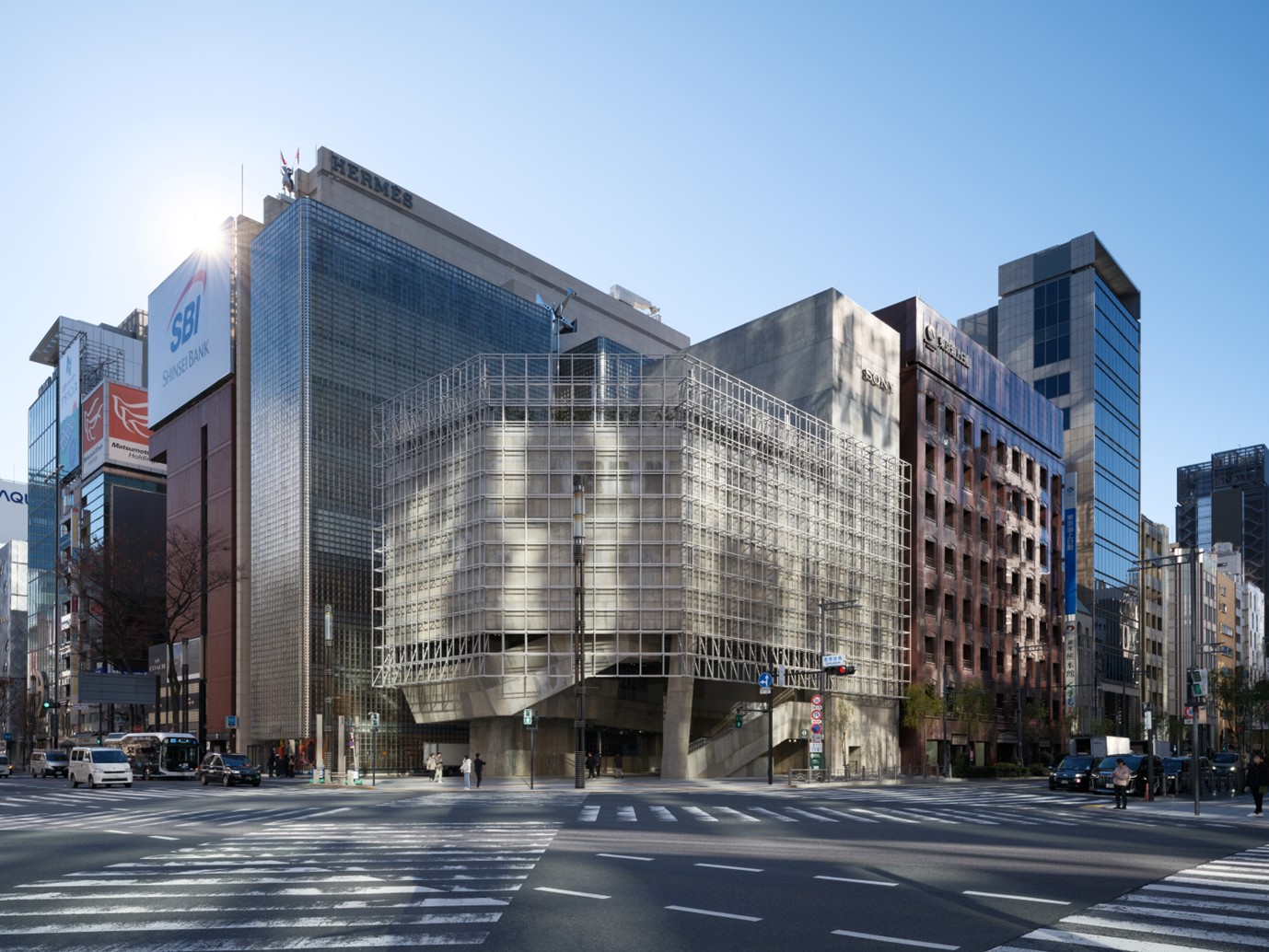
Ginza Sony Park is an "urban park" located at the Sukiyabashi intersection in Ginza, Tokyo. A park is inherently a place where people can freely interact and new experiences are born, precisely because it has open spaces with no predetermined uses. Ginza Sony Park has designed itself to have "open spaces," becoming a public space that visitors can use freely, and giving rise to new "activities." This also inherits the concept of "a facility open to the city" that Sony Building has always valued.
The distinctive building, with four underground floors and five above-ground floors, is deliberately kept to about half the height of a typical Ginza building, bringing spatial openness and rhythm to the city. The ground floor opens onto the street on three sides and is directly connected to the subway and underground parking garage. Furthermore, the large atrium structure extending from the first underground floor to the second above-ground floor, and the vertical promenade, make the seamless connection with the city more urban and three-dimensional.
Ginza Sony Park does not have permanent tenants, instead utilizing its open spaces to offer a variety of activities. On the B3 floor, the casual dining restaurant [Nibun no Ichi], based on Western cuisine, offers a new experience through food.
Ginza Sony Park, born from a redefinition of urban parks, continues to generate a new rhythm for the city and its people through its combination of open spaces and activities.
Sony Park Official Website and Social Media Accounts
Web: https://www.ginzasonypark.com/
Instagram: https://www.instagram.com/ginzasonypark/
X: https://x.com/ginzasonypark/
Facebook: https://facebook.com/ginzasonypark/
YouTube: https://youtube.com/ginzasonypark/
@ginzasonypark #GinzaSonyPark
[Sony Corporation] Press Release
<Related articles from the past>
"Kumamoto Mon x Tokyo Ginza" Special Collaboration to be held at Ginza Sony Park from January 31st

