





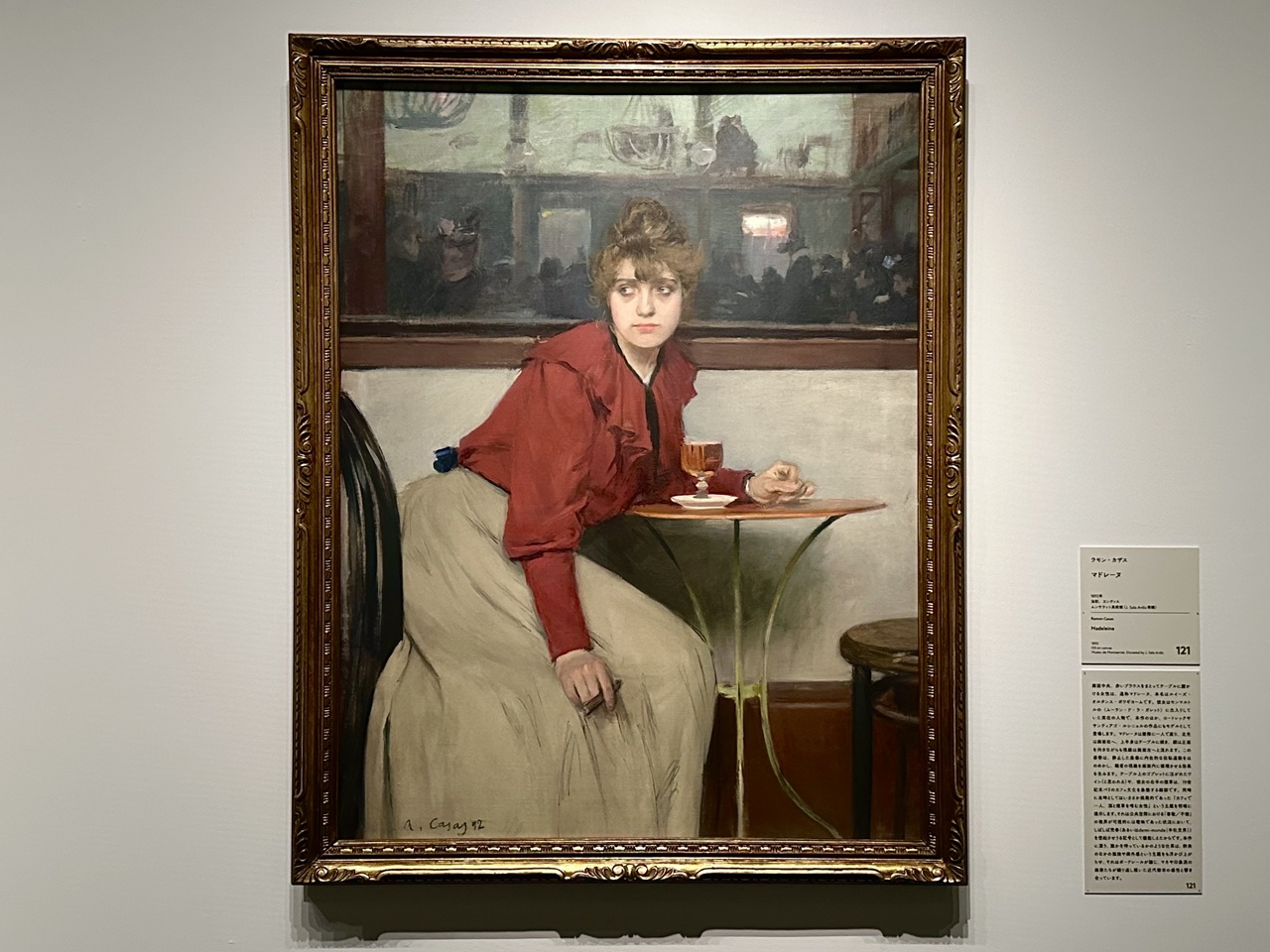
Top visual: Ramon Casas, *Madeleine*, 1892, Munsalat Museum (donated by J. Sala Ardiz)
From the late 19th century onward, numerous "cafés" sprang up in Paris. These were not simply places to enjoy food, drink, and conversation; they were social gathering places where artists and critics, aiming to break away from the traditional salons (official exhibitions), transcended social status, nationality, and genre to discuss new forms of art and find creative inspiration.
"There was constant clash of opinions, and that stimulation kept our minds sharp. We were encouraged to pursue sincere inquiry, free from self-interest, and the enthusiasm we gained sustained us for weeks, continuing until one idea took clear form."
—For example, Claude Monet later recalled his days at Café Guerbois in Montmartre. This café is known as a gathering place for young Monet's idol, Édouard Manet, as well as Auguste Renoir and Edgar Degas, and is said to have been instrumental in establishing the Impressionist exhibitions.
The Mitsubishi Ichigokan Museum in Marunouchi, Tokyo, is currently hosting an exhibition titled "Artists Gathering in 'Cafes'—From Impressionism to Van Gogh, Toulouse-Lautrec, and Picasso," which looks back on the impact that cafes of the late 19th and early 20th centuries, often considered the cradle of modern art , had on art. The exhibition runs until September 23, 2026 (Wednesday, national holiday).
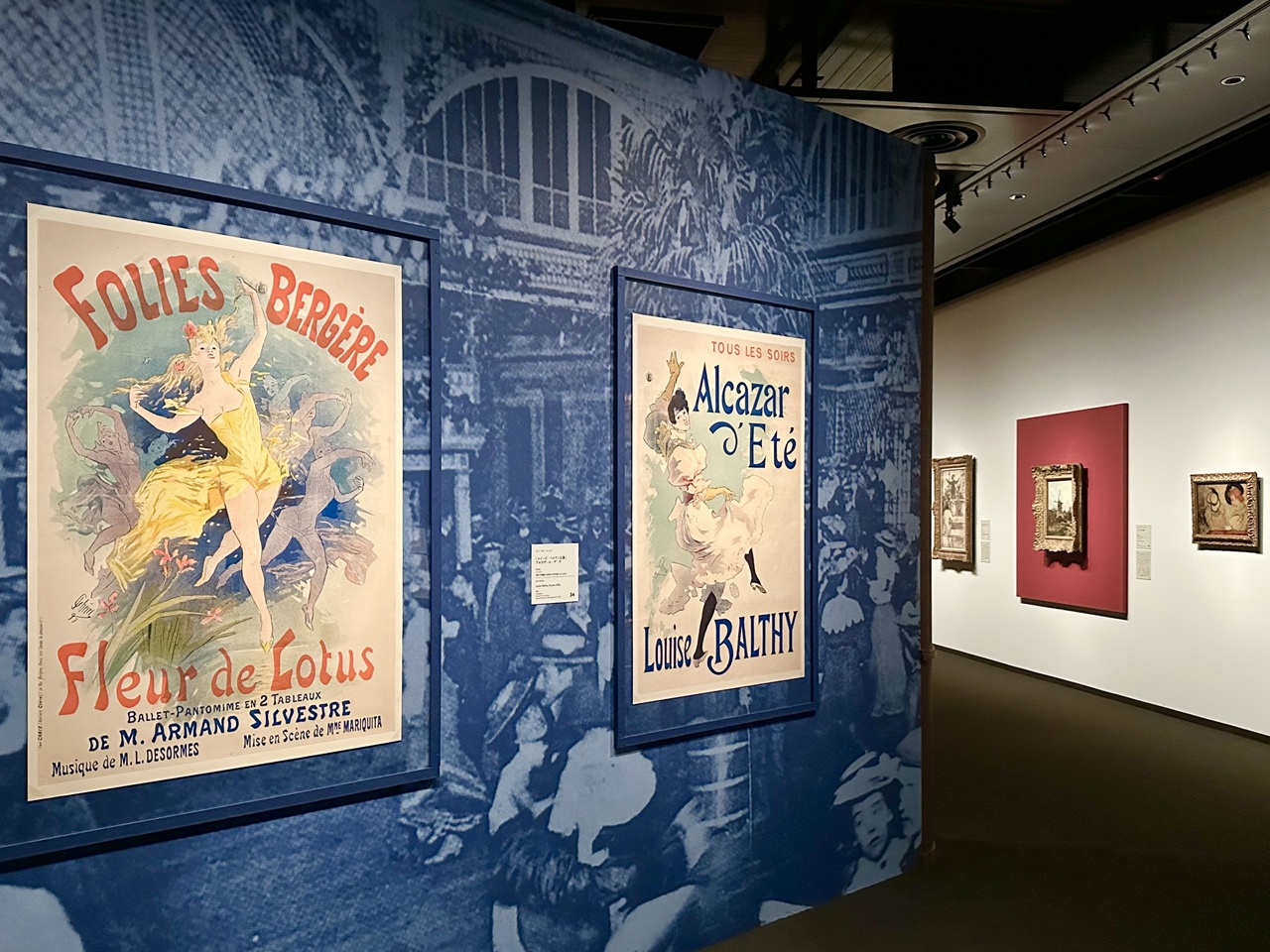
Exhibition view
This exhibition is a joint project of the Mitsubishi Ichigokan Museum and the Hiroshima Museum of Art. It features approximately 130 works, primarily from the collections of both museums, presented in three chapters.
*Some exhibits will be changed between the first period (June 13th to August 2nd) and the second period (August 4th to September 23rd). Please check the list of exhibited works on the official website for details.
In this exhibition, "café" does not refer only to the everyday relaxation spaces we imagine today. It encompasses a broader range of cultural spaces filled with the cutting edge culture of the time, including café-concerts where performers presented music and singing in addition to food and drink; guinguettes, popular taverns mainly located in the suburbs of Paris or along rivers where people could dance; and cabarets , smaller than café-concerts, where artistic activities such as improvisational poetry readings, plays, and shadow puppetry took place.
Chapter 1: "Painting Cafes—From Realism to Impressionism"
Chapter 1 focuses on the new themes in modern painting that Paris, transformed into a modern city, brought about.
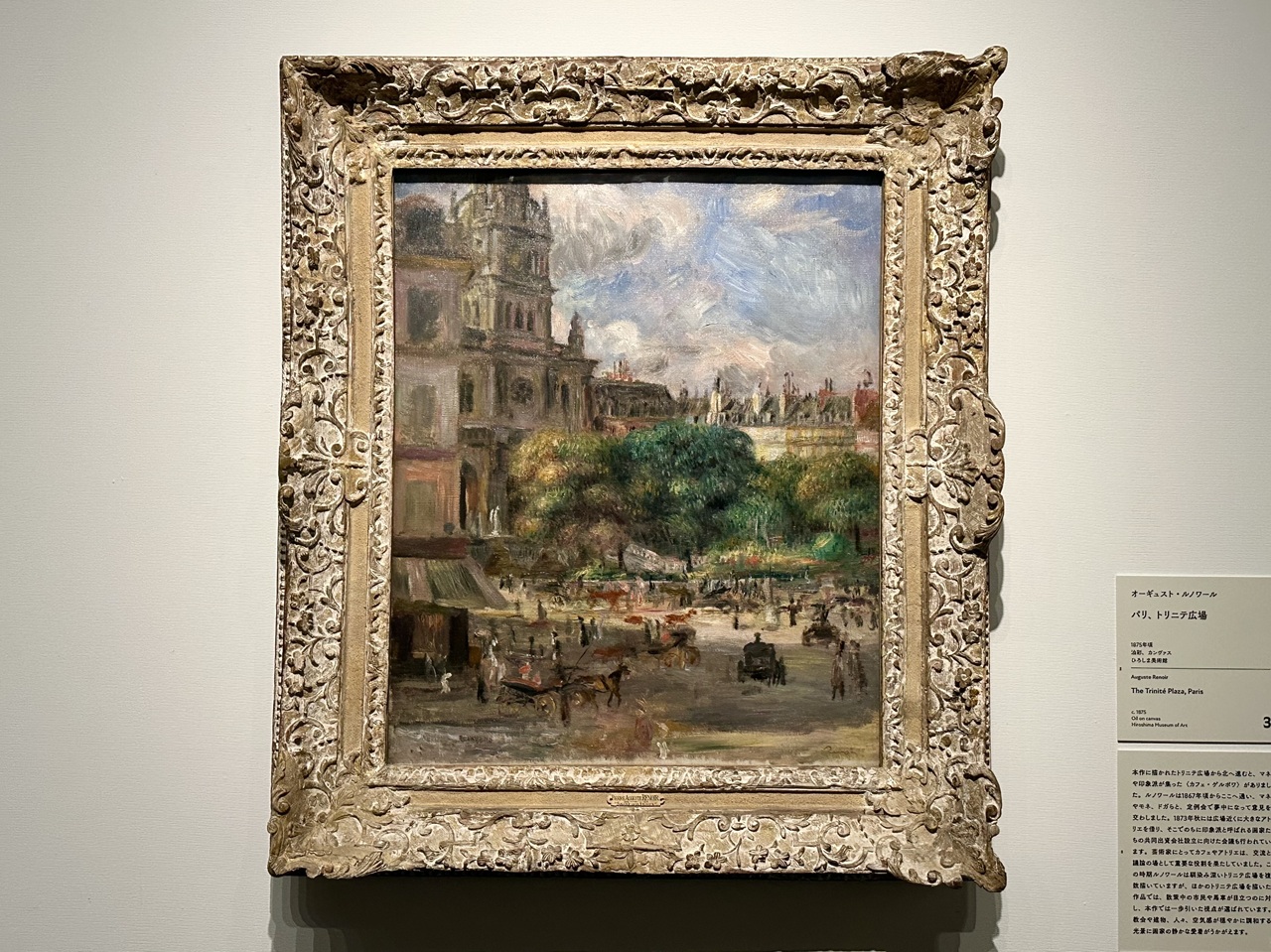
Auguste Renoir, "Place de Trinité, Paris," circa 1875, Hiroshima Museum of Art
In the late 19th century, Paris underwent large-scale urban reforms under the orders of Napoleon III. At that time, there were few places to exhibit works other than the official Salon (official exhibition), which held authority in the art world, and being recognized by the Salon was the surest path to success as a painter. Inevitably, the mainstream of the art world consisted of religious paintings and narrative paintings based on classical works, adhering to the academic style since the Renaissance, which the Salon highly valued. It was the poet and art critic Charles Baudelaire who challenged this situation.
In his 1863 art critique, "A Painter of Modern Life," Baudelaire argued that the role of the modern artist was not to imitate past ideals, but to express the aesthetic qualities found in the ever-changing "present"—that is, "modernity"—as art. In response to this philosophy, Manet and the Impressionist painters who gathered at Café Guerbois found new themes in the everyday life around them.
The bustling main streets filled with citizens dressed in the latest fashions, the suburban leisure areas symbolizing the flourishing leisure culture brought about by the development of the railway network and industrialization, and of course, the cafes brimming with creative energy are prime examples.
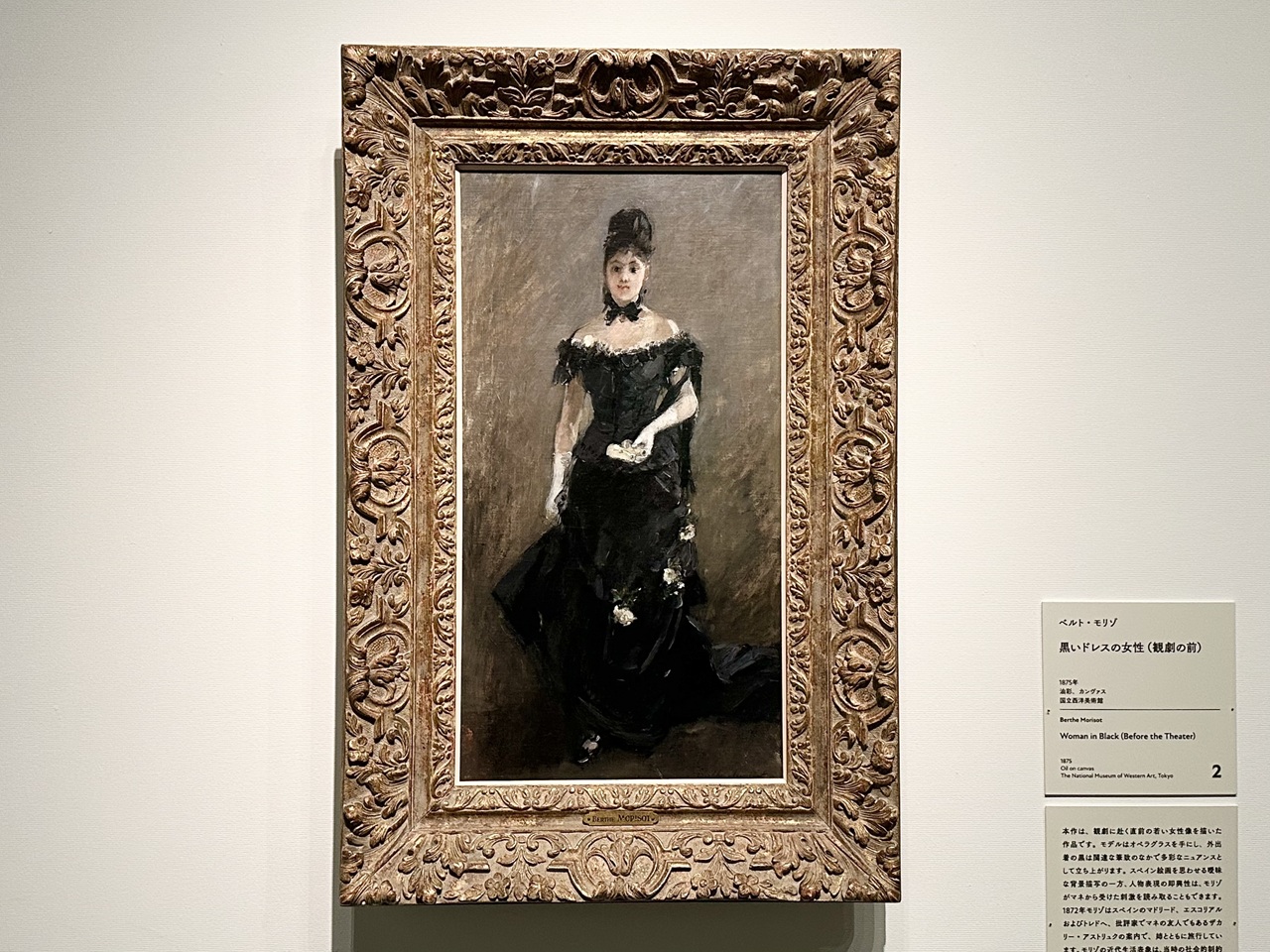
Berthe Morisot, "Woman in a Black Dress (Before the Theater)," 1875, National Museum of Western Art.
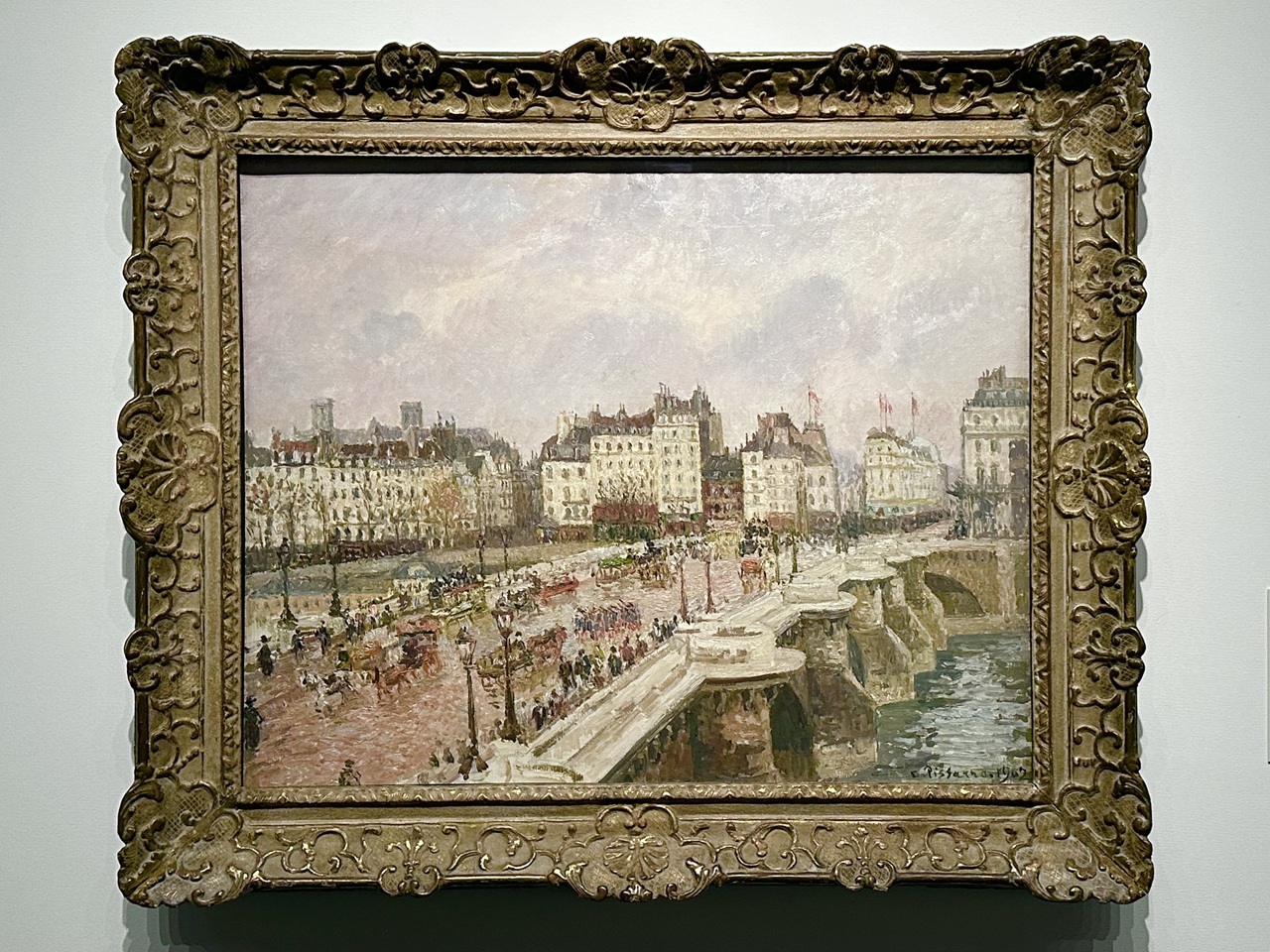
Camille Pissarro, *Pont Neuf*, 1902, Hiroshima Museum of Art.
Degas, in particular, focused on the theater as his subject from around 1871, and his depictions of dancers had a profound influence on subsequent painters, including Jean-Louis Forin and Gaston La Touche. He also repeatedly depicted men in top hats (wealthy patrons and regulars who supported the theater) watching the dancers from the wings or in rehearsal rooms, and this was continued by Forin and others, solidifying the image as a symbol of the human drama in the theater world behind the glamorous stage.
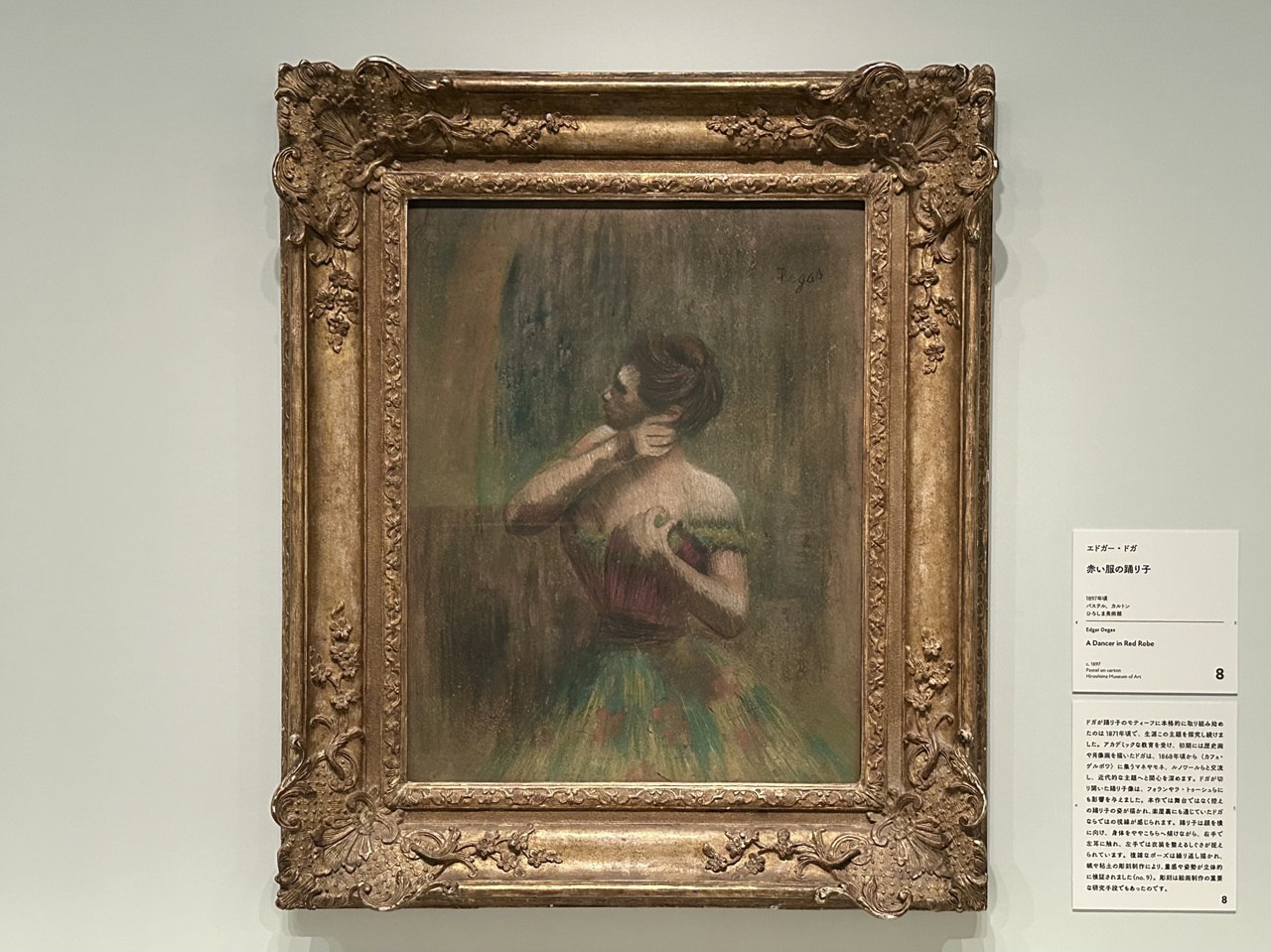
Edgar Degas, "Dancer in a Red Dress," circa 1897, Hiroshima Museum of Art.
"Dancer in a Red Dress" (c. 1897) captures a fleeting moment of a dancer adjusting her appearance. This perspective is characteristic of Degas, who grew up familiar with ballet at the old opera house near his family home and, through acquaintances and friends, was also familiar with the backstage world.
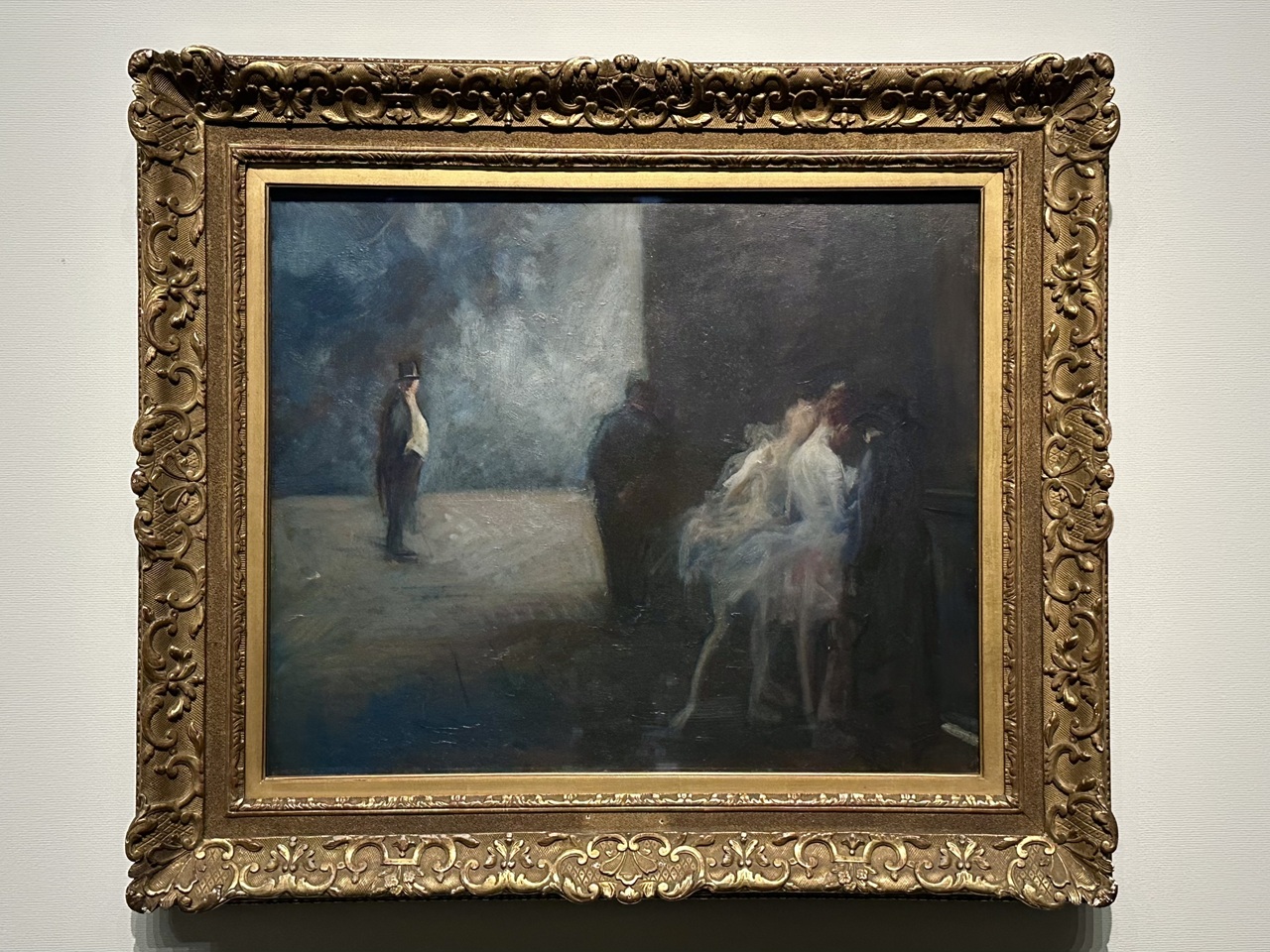
Jean-Louis Folin, "Backstage – Blue Symphony," circa 1900-23, Ohara Museum of Art, Ohara Foundation for the Arts.
This chapter also features works by Honoré Daumier and Paul Gavarni, Realist painters and printmakers who depicted the interiors of cafes and theaters, predating the Impressionists. For them, cafes, where people from all walks of life—the wealthy, intellectuals, laborers, and prostitutes—shared a common space, were a microcosm of modern society and an ideal subject for observation and criticism. With the development of letterpress printing and the spread of lithography, these caricatures depicting everyday life circulated widely through newspapers and satirical magazines.
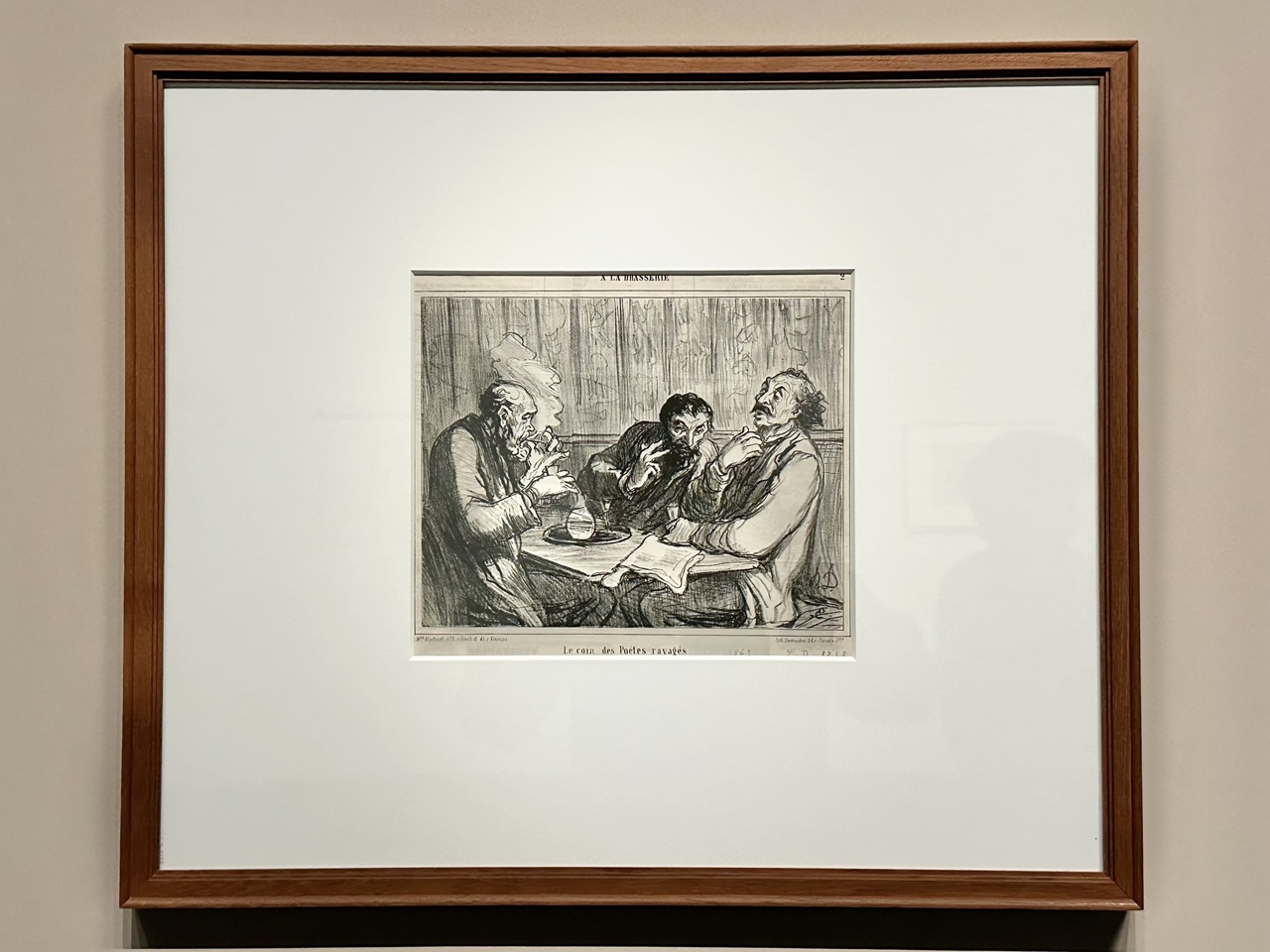
Honoré Daumier, "In the Brasserie 2: A Corner Where Dissolute Poets Gather," 1863, Itami City Museum, Early Exhibition.
Furthermore, Kei Iwase of the Mitsubishi Ichigokan Museum, the curator in charge of this exhibition, says, "Windmills are a key theme of this exhibition." For example, "Moulin de la Galette," which Léon Jacques depicted in an etching in 1862, was originally a row of windmills used for grinding flour on Montmartre Hill. As modernization progressed, its role changed, evolving from a rest stop selling bread and milk to a guinguette, and eventually into an open-air dance hall. It can be said to be one of the motifs that strongly embodies the "modernity" that Baudelaire advocated.
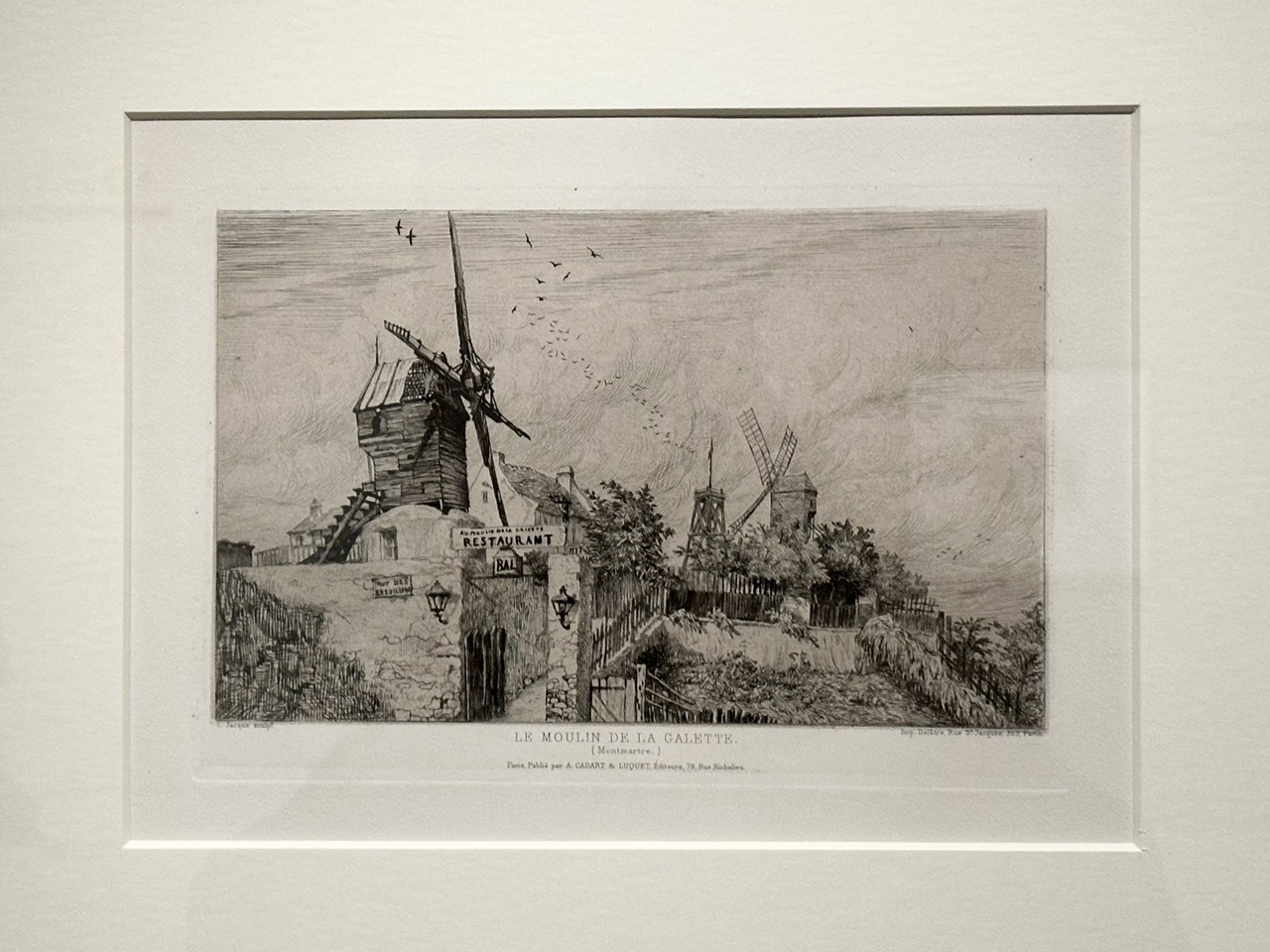
Léon Jacques, "Moulin de la Galette (Montmartre) 'Journal of the Society of Etching Engravers: Modern Etching Engravings'," 1862-67, Machida City Museum of Graphic Arts, Early Exhibition.
While the windmills evoke a nostalgic, old-world village atmosphere, Montmartre was also a symbol of modern Parisian entertainment culture, attracting many people from the city on weekends who dressed up and danced. Many masters, including Renoir, who had his studio in Montmartre, were captivated by the place, capturing on canvas the windmills' appearance, the hustle and bustle inside, and the pervasive sense of weariness—each artist who was drawn to the place. In addition to Jacques, this exhibition features works by Vincent van Gogh, Ramon Casas, and Maurice Utrillo, presented across different chapters.
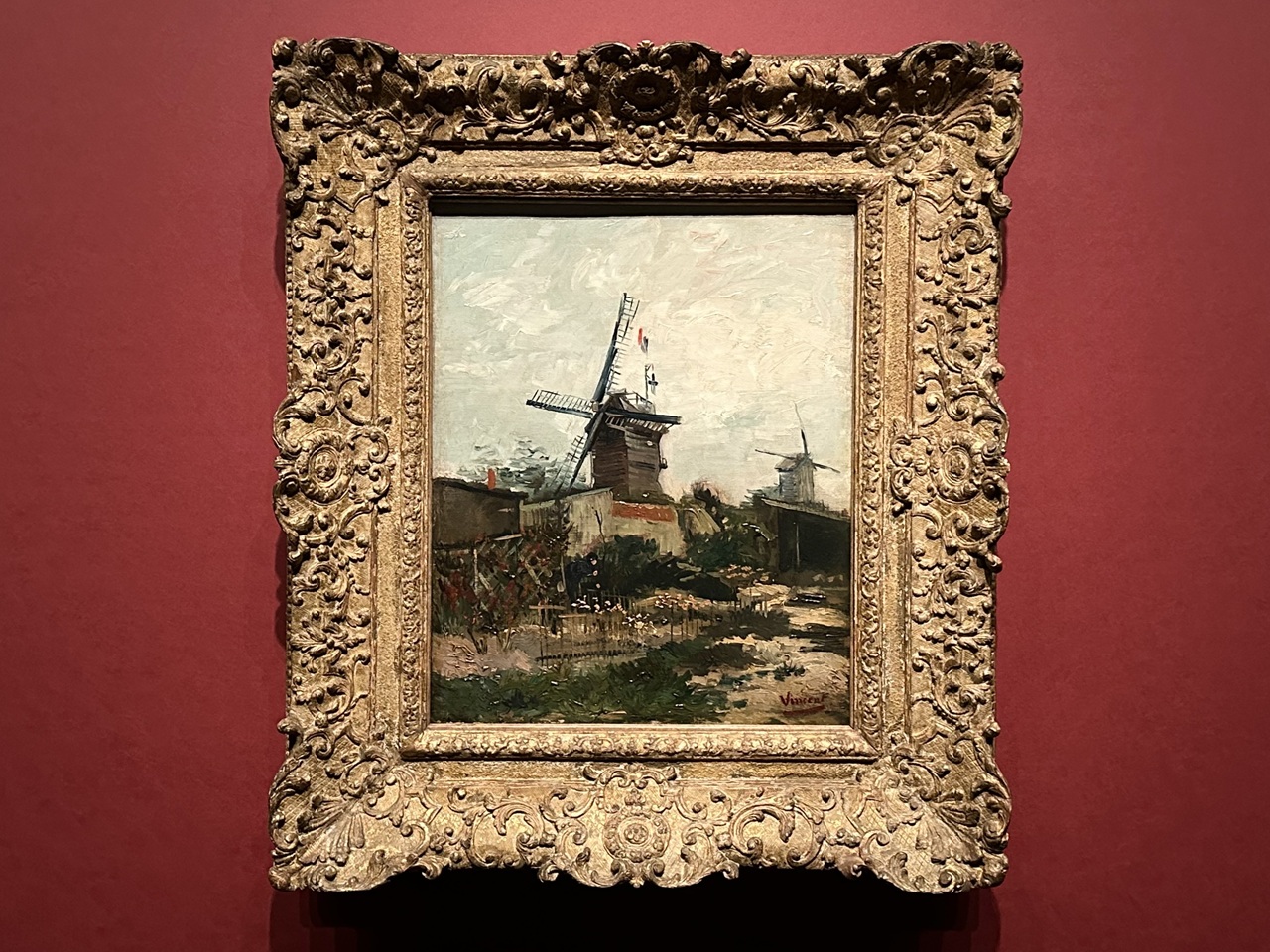
Exhibited in Chapter 2: Vincent van Gogh's "Windmills at Montmartre," 1886, Ishibashi Foundation Artizon Museum.
Chapter 2: "Night Cafes—Chéret, Toulouse-Lautrec's Fin de Siècle"
In the late 19th century, the development of boulevards and gas lamps made nighttime outings commonplace. Fueled by a growing appreciation for nightlife, entertainment venues such as cafes-concerts and cabarets sprang up one after another in Montmartre. Theaters, once exclusively for the aristocracy, also became more accessible to the general public. Each establishment competed for customers, using star singers and popular dancers to attract patrons. Chapter 2 focuses on the poster art that flourished as a means of advertising these establishments.
Until the mid-19th century, color lithography required preparing a separate plate for each color, which was incredibly time-consuming and costly. Jules Chéret greatly simplified this process, making a significant contribution to the development of advertising art.
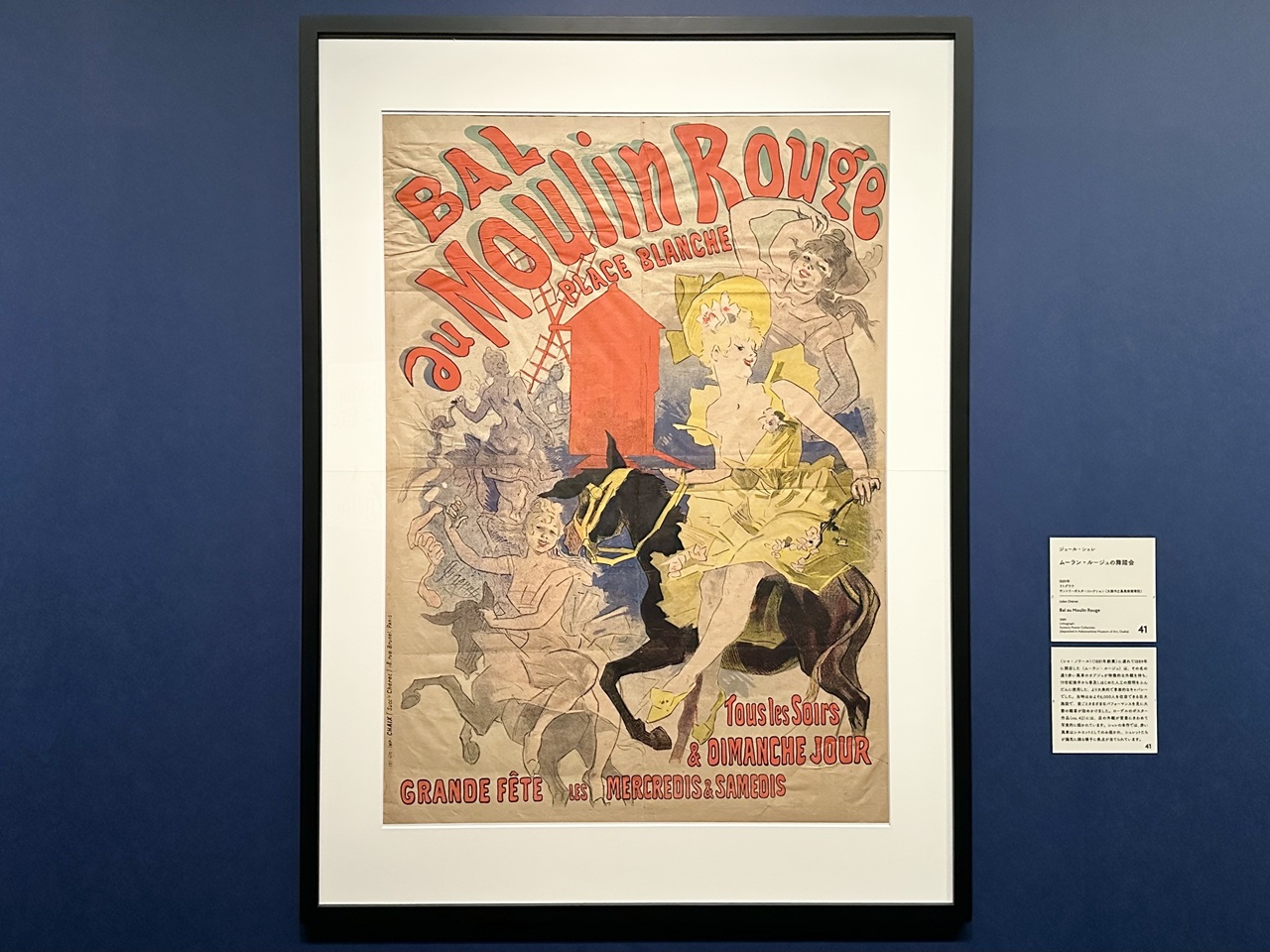
Jules Chéret, *A Ball at the Moulin Rouge*, 1889, Suntory Poster Collection (on loan to the Nakanoshima Museum of Art, Osaka)
Scherette established a technique for expressing rich hues and light and shadow by skillfully layering three color plates: red, yellow, and blue. Her posters were innovative in that they didn't prominently feature the facility or product being advertised, but instead centered on a cheerful and open Rococo-style female figure (nicknamed "Scherette").
The imagery that highlighted the healthy allure of the nightlife quickly swept Paris. Its influence was so great that it was said, "Paris without Chéret is unimaginable." In this way, Chéret evolved posters from mere advertisements into modern art, forming a junction between art and popular culture. Among them, the advertising poster for the legendary cabaret Moulin Rouge (Red Windmill), which opened in 1889 and could accommodate as many as 6,000 customers, was praised for its "fairytale-like beauty."
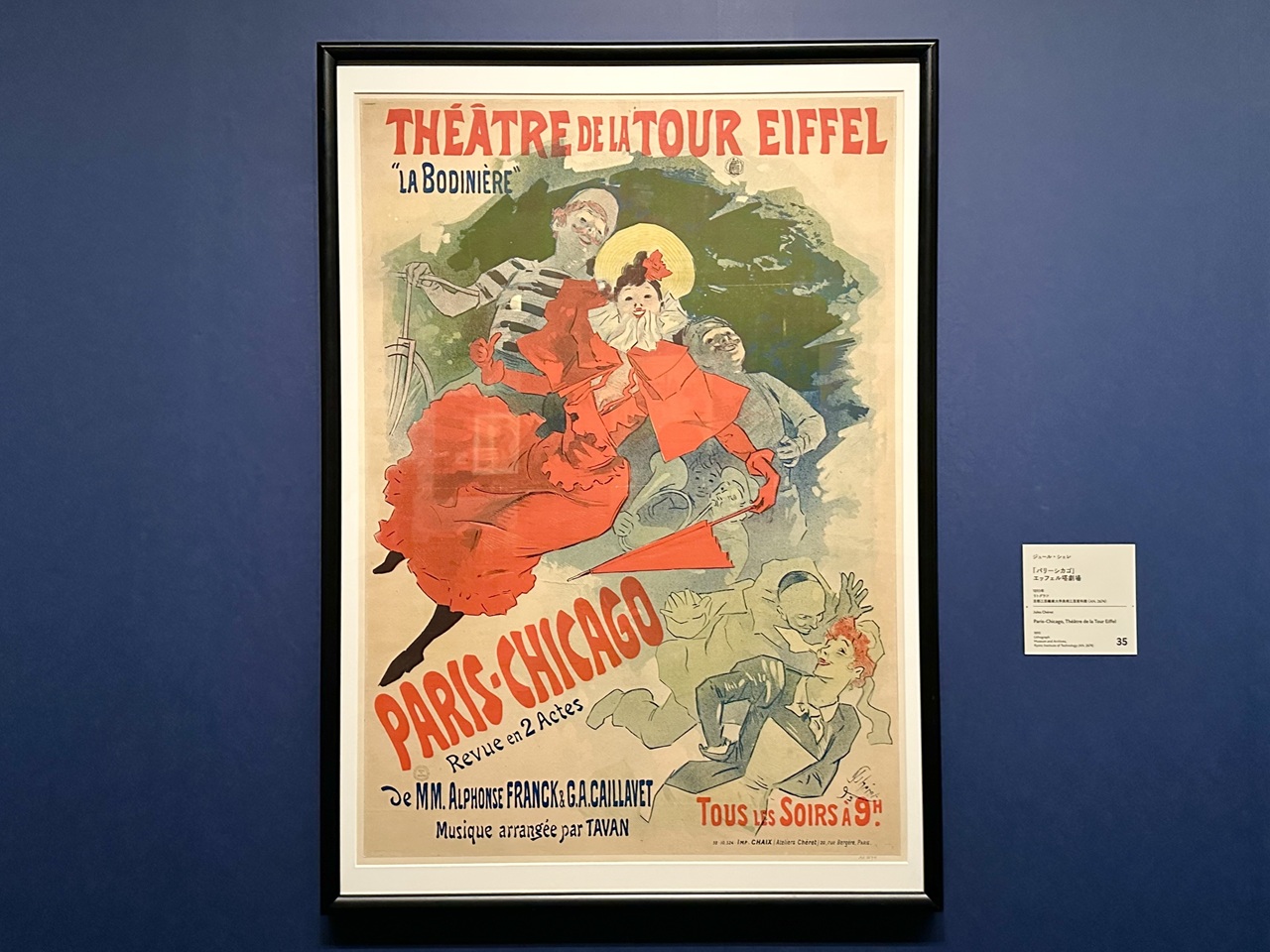
Jules Chéret, "Paris-Chicago: Eiffel Tower Theatre," 1893, Kyoto Institute of Technology Museum of Art and Design (AN.2674), Early Exhibition.
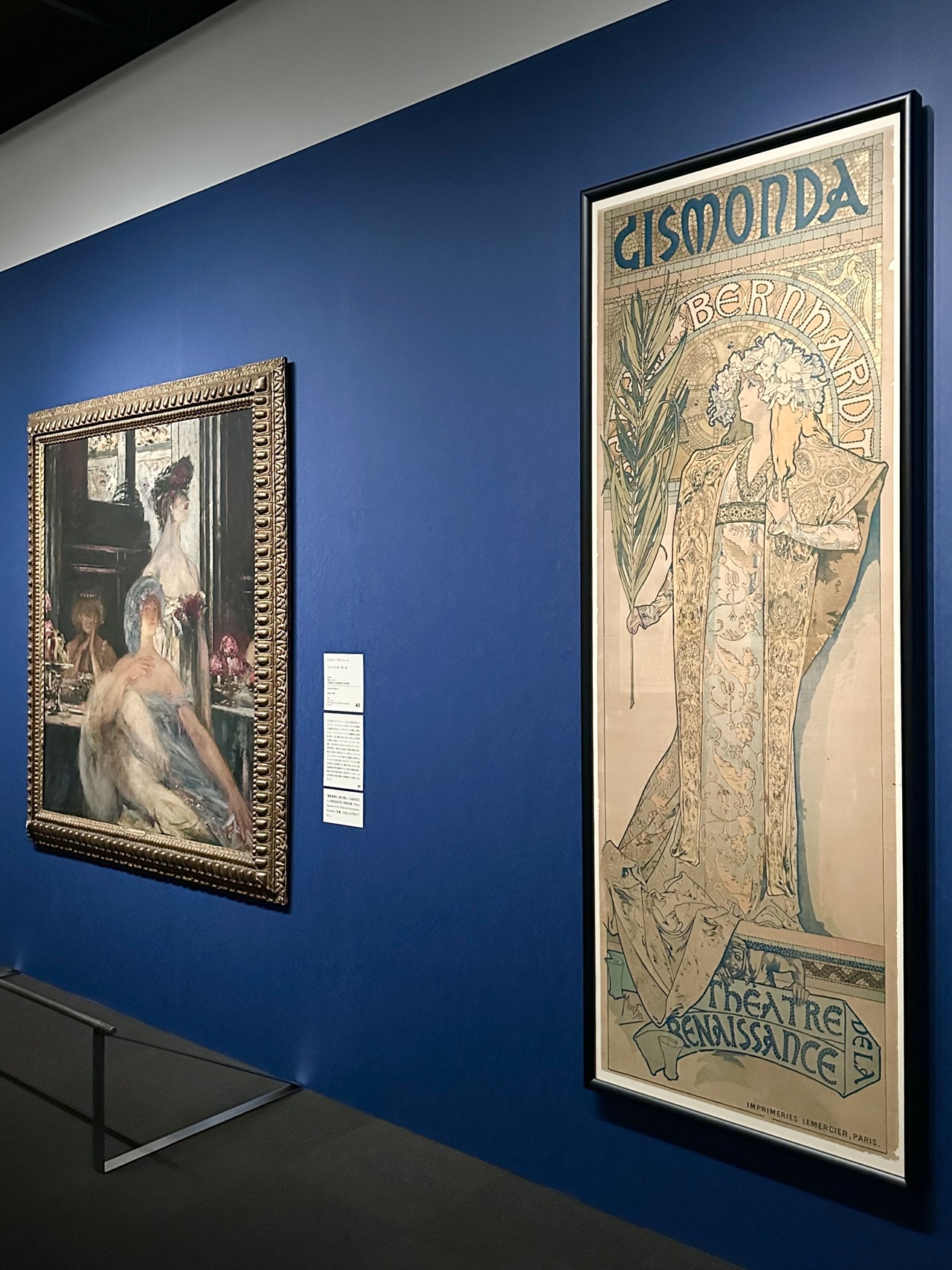
Exhibition view, from right: Alphonse Mucha, "Gismonda," 1894, Kyoto Institute of Technology Museum of Art and Design (AN.3275), first half of the exhibition / Georges Devallière, "Music Hall," 1903, Ohara Museum of Art, Ohara Foundation for the Arts.
Henri de Toulouse-Lautrec, along with Alphonse Mucha, elevated the poster art pioneered by Chéret to new heights. Toulouse-Lautrec frequented cabarets and cafes-concerts, constantly observing the behavior of the stars and the unique energy of the nightlife. Unlike Chéret, who developed idealized female figures, through these immersive experiences, he built a unique style of expression that exaggerated rather than beautified the characteristics of people, sharply depicting their essence.
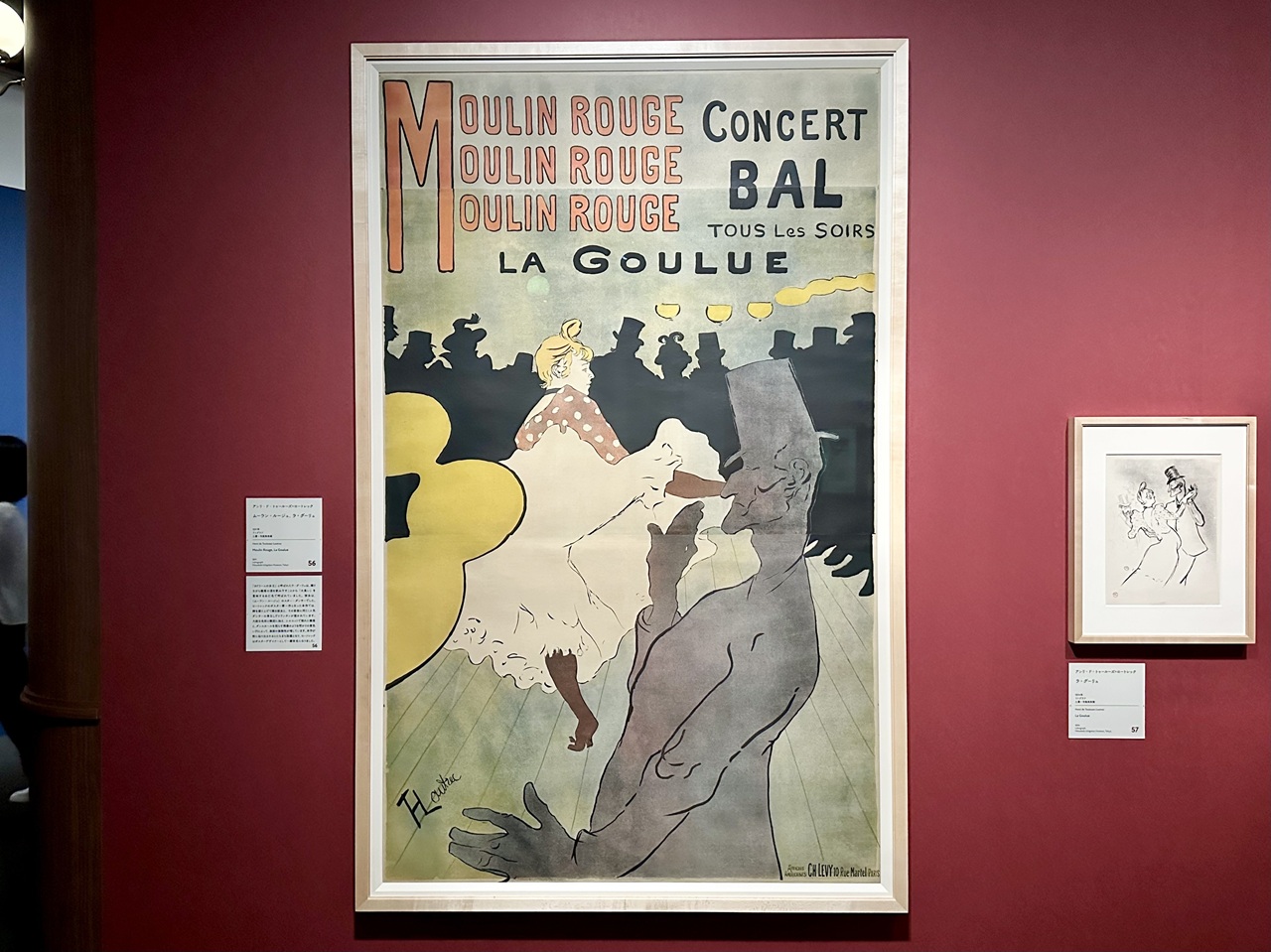
Exhibition view; in the center is Henri de Toulouse-Lautrec's "Moulin Rouge, La Goulue," 1891, Mitsubishi Ichigokan Museum.
"Moulin Rouge, La Goulue" (1891) is Toulouse-Lautrec's landmark first poster. Commissioned by the manager of the Moulin Rouge, its subject is La Goulue, the star dancer who earned the nickname "the glutton" for her lavish drinking of the audience's drinks. Her dance partner, "Valentin the Boneless," and the audience are depicted in silhouette, and the surrounding lighting is portrayed in the same yellow as La Goulue's hair, giving the impression that she herself is part of the radiance.
With its simple lines reminiscent of Ukiyo-e prints and bold composition, this work leaves a striking impression. Thousands of copies were plastered on the streets of Paris, solidifying the image of Montmartre, the entertainment district. Toulouse-Lautrec himself became instantly famous as a poster designer.
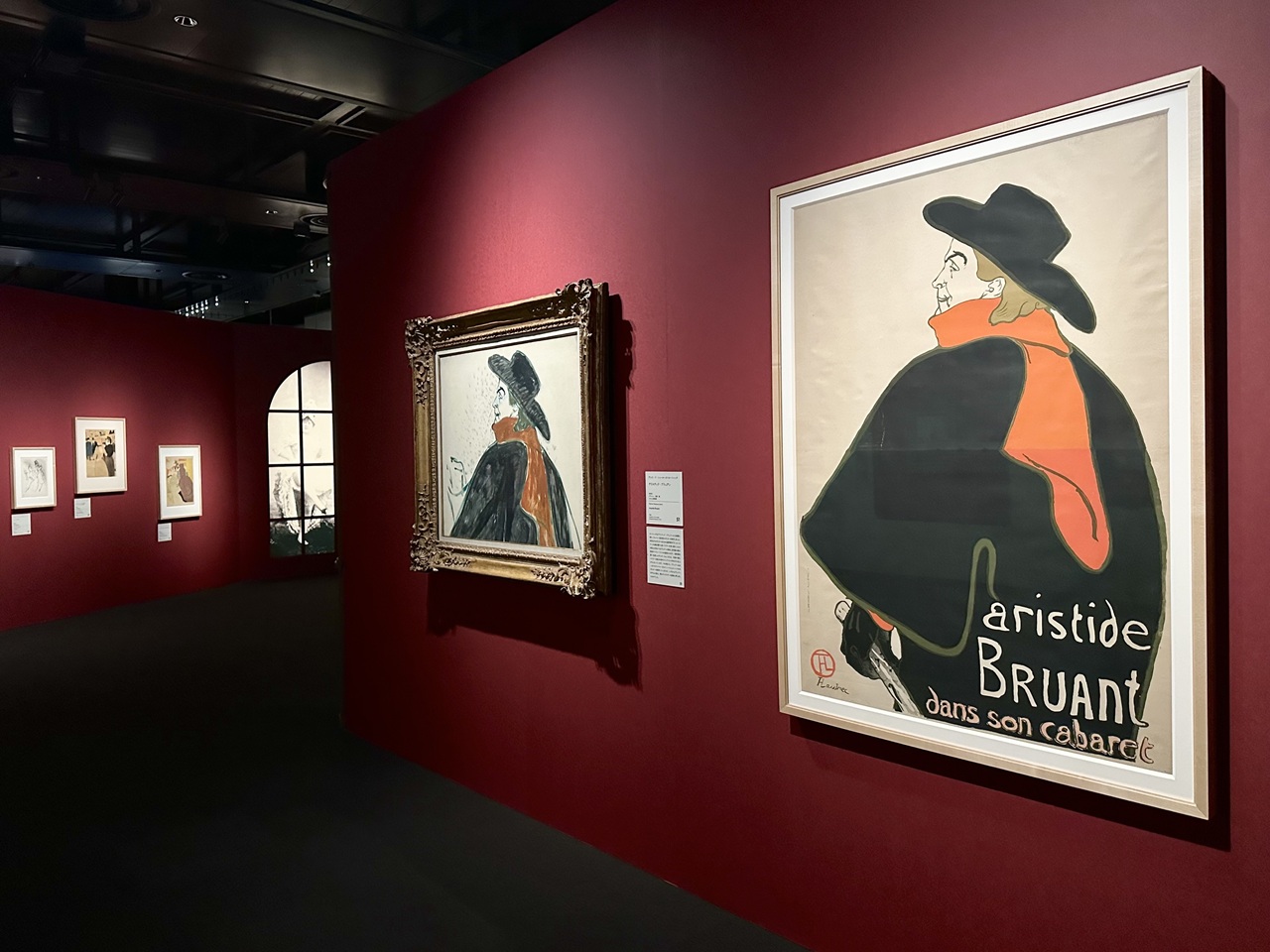
Exhibition view; on the right is Henri de Toulouse-Lautrec's "Aristide Bruant at His Cabaret," 1893, Mitsubishi Ichigokan Museum.
Although not a poster, one of the most interesting works in the Toulouse-Lautrec exhibition is "Refrain of a Chair in the Style of Louis XIII (At Aristide Bruant's Cabaret)" (1886). Toulouse-Lautrec himself is depicted behind the singer Aristide Bruant, who is conducting, and it has been suggested that the bearded man standing next to him may be Van Gogh.
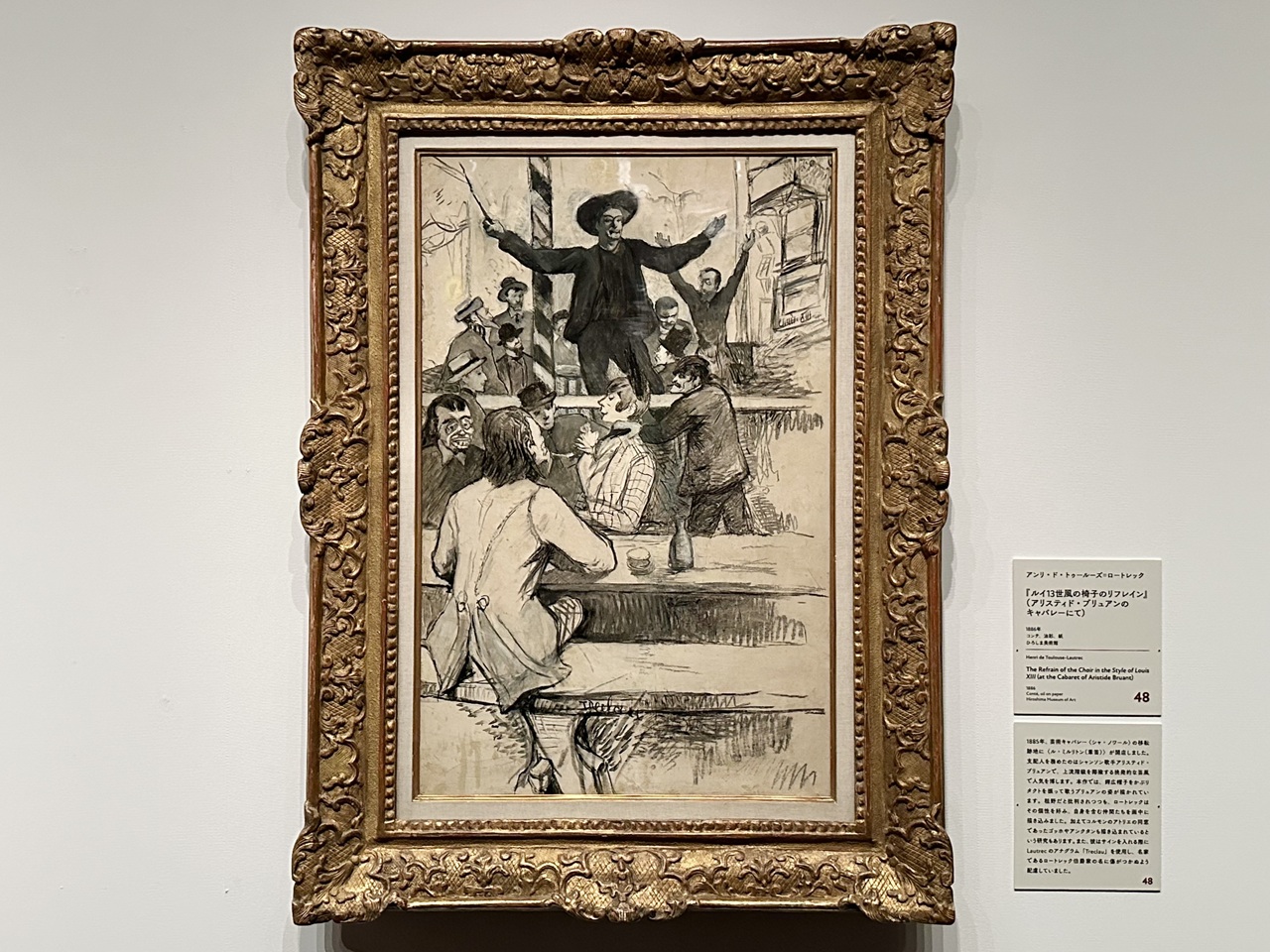
Henri de Toulouse-Lautrec, "Refrain of a Chair in the Style of Louis XIII (At Aristide Bruant's Cabaret)," 1886, Hiroshima Museum of Art.
In fact, Toulouse-Lautrec and Van Gogh were classmates at Fernand Cormon's art school. Toulouse-Lautrec, born into an aristocratic family, was free-spirited and disliked restrictions, while Van Gogh was a straightforward man who sought ideals and solidarity. Although their temperaments and artistic styles were completely different, neither was satisfied with learning at an academic art school, and instead nurtured their art in cafes near Montmartre, which were closely intertwined with their lives and social circles. If it can be confirmed that this person is indeed Van Gogh, this work will be an important example that visually conveys the relationship between the two.
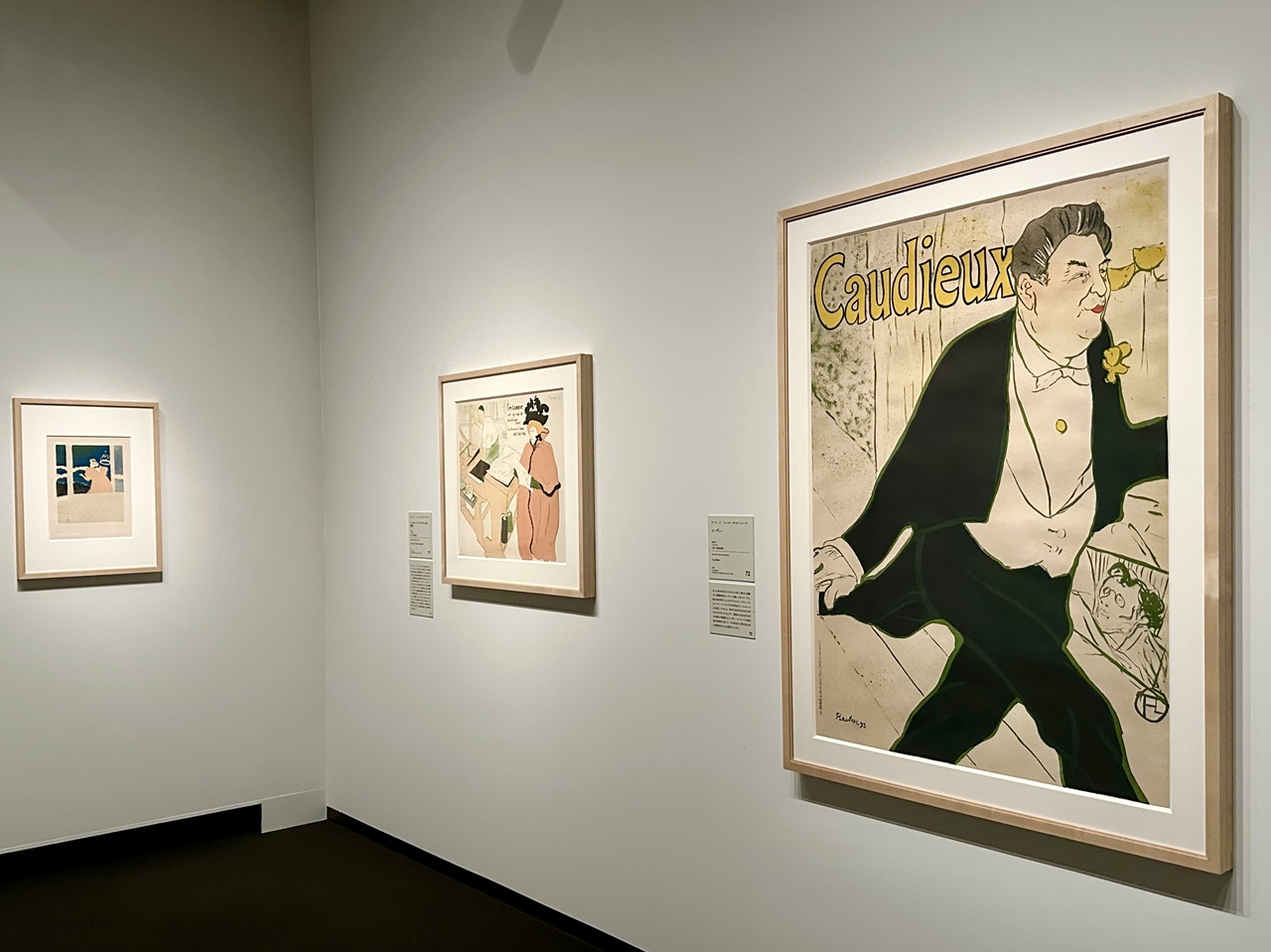
Exhibition view; on the right is Henri de Toulouse-Lautrec's "Cordieu," 1893, Mitsubishi Ichigokan Museum.
Chapter 3: "The Emergence of 'Le Chat Noir' and Subsequent Developments—Travels Between Paris and Barcelona"
Chapter 3 begins by focusing on the avant-garde cabaret "Le Chat Noir" (The Black Cat), which Rodolphe Sallis opened in 1881 and became a testing ground for a wide range of arts, including poetry, music, visual arts, and theater, earning it the nickname "the brain of Paris."
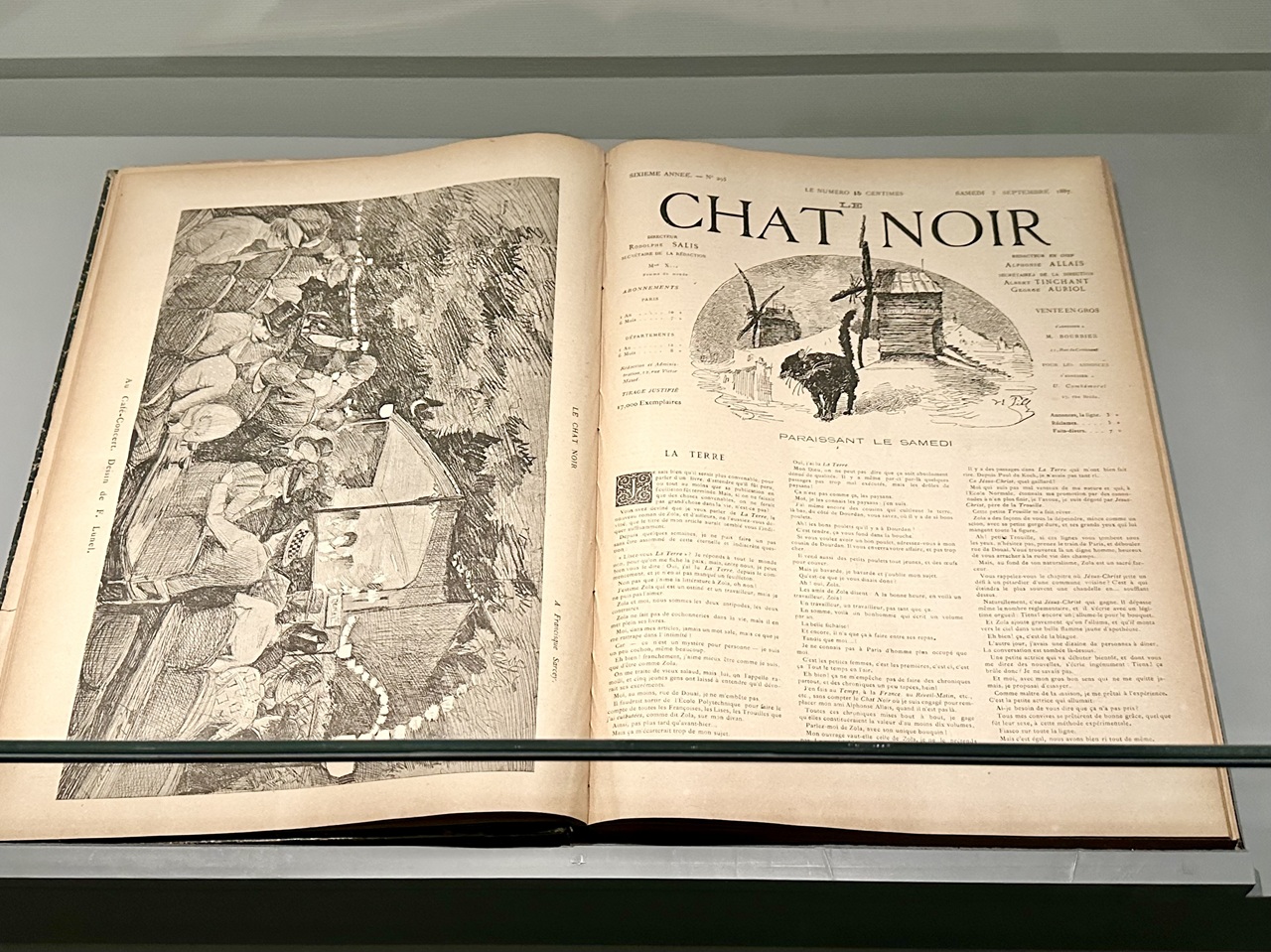
The journal "Chat Noir," issues 294 and 295, dated August 27, 1887 and September 3, 1887.
Among the various activities of the shop, including the publication of its exclusive magazine "Le Chat Noir," the shadow puppet show created by Henri Rivière attracted considerable attention. It is said to be the prototype for later films and animations, and Nabis painters such as Félix Vallotton were also inspired by the shadow puppet show, which emphasized flatness.
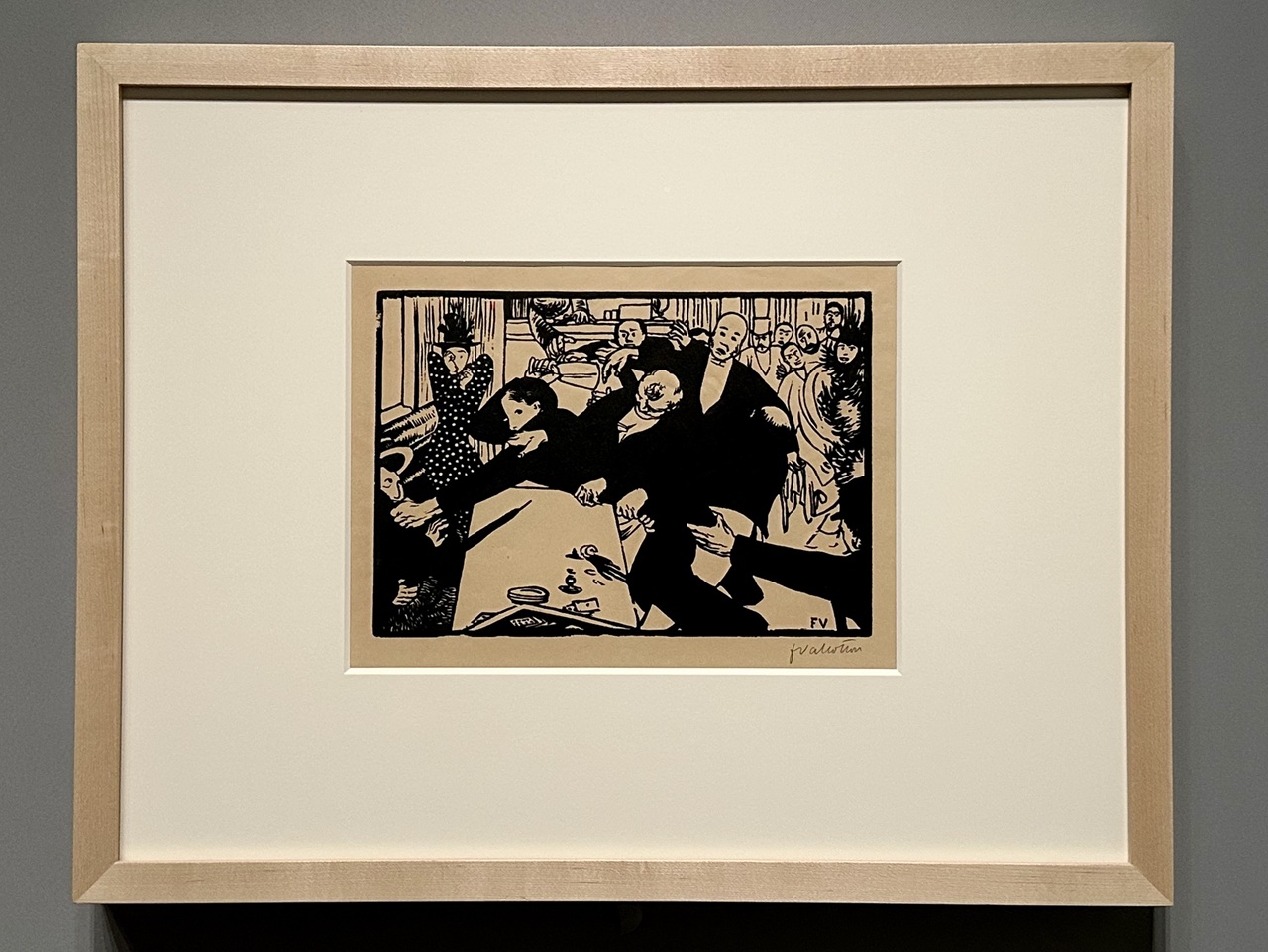
Félix Vallotton, "The Commotion, or Scene in a Café," 1892, Mitsubishi Ichigokan Museum.
Following its enthusiastic popularity, Sallis began touring throughout France. The image of a defiant black cat depicted in the promotional poster "Le Chat Noir Tour" (1896), created by Théophile Alexandre Steinlen, visualized the free artistic spirit of the cabaret and became an enduring icon symbolizing the establishment itself.
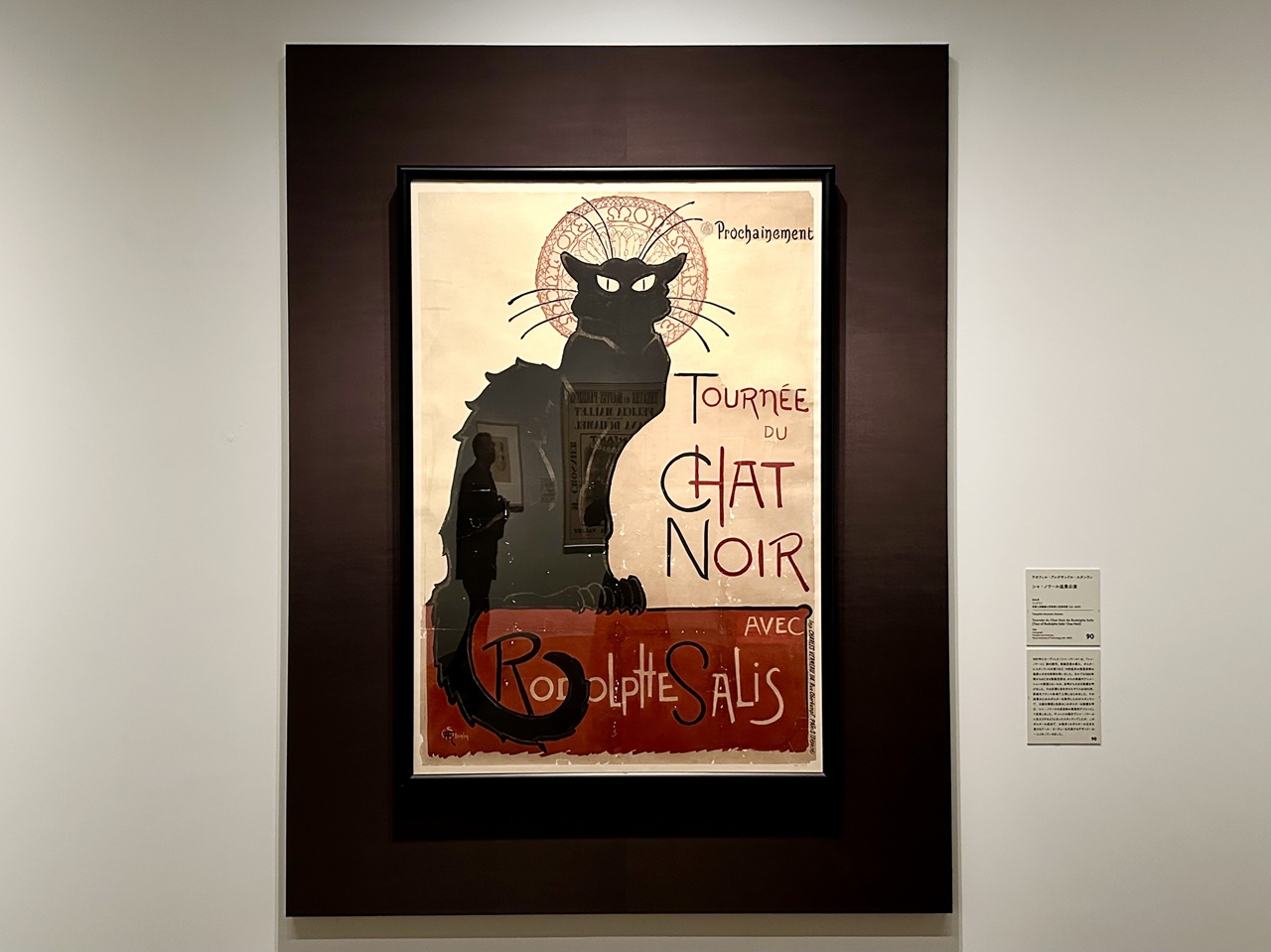
Théophile Alexandre Steinlen, "The Le Chat Noir's Tour," 1896, Kyoto Institute of Technology Museum of Art and Design (AN.4829), Early Exhibition.
The influence of bohemian café culture also reached Barcelona in Catalonia, Spain, which was connected to Paris by the development of the railway network. Catalan painters Ramon Casas and Santiago Rusiñol opened "Quatre Gats" (Four Cats) , modeled after "Le Chat Noir" (The Black Cat), in Barcelona's old town in 1897. They spearheaded the "Modernisme" movement, which aimed to create new art linked to Catalan culture.
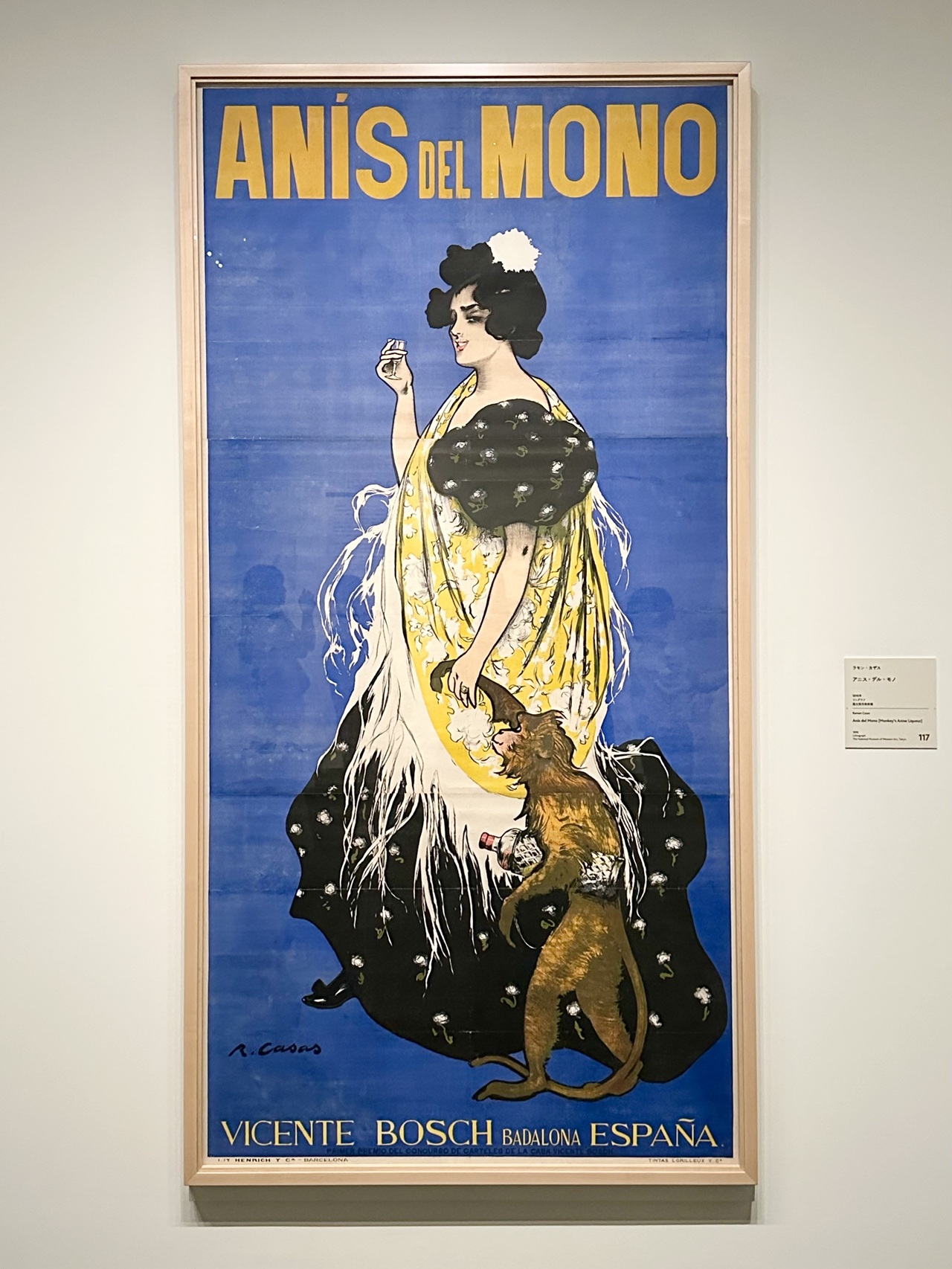
Ramon Casas, *Anis del Mono*, 1898, National Museum of Western Art, Early Exhibition Period.
Rusiñol's "Café de Zancoheran" (1889-90) and Casas's "Madeleine" (1892), which came to Japan from the Munzarat Museum in Spain, are valuable examples illustrating the spread of café culture to Spain and are the highlights of this chapter.
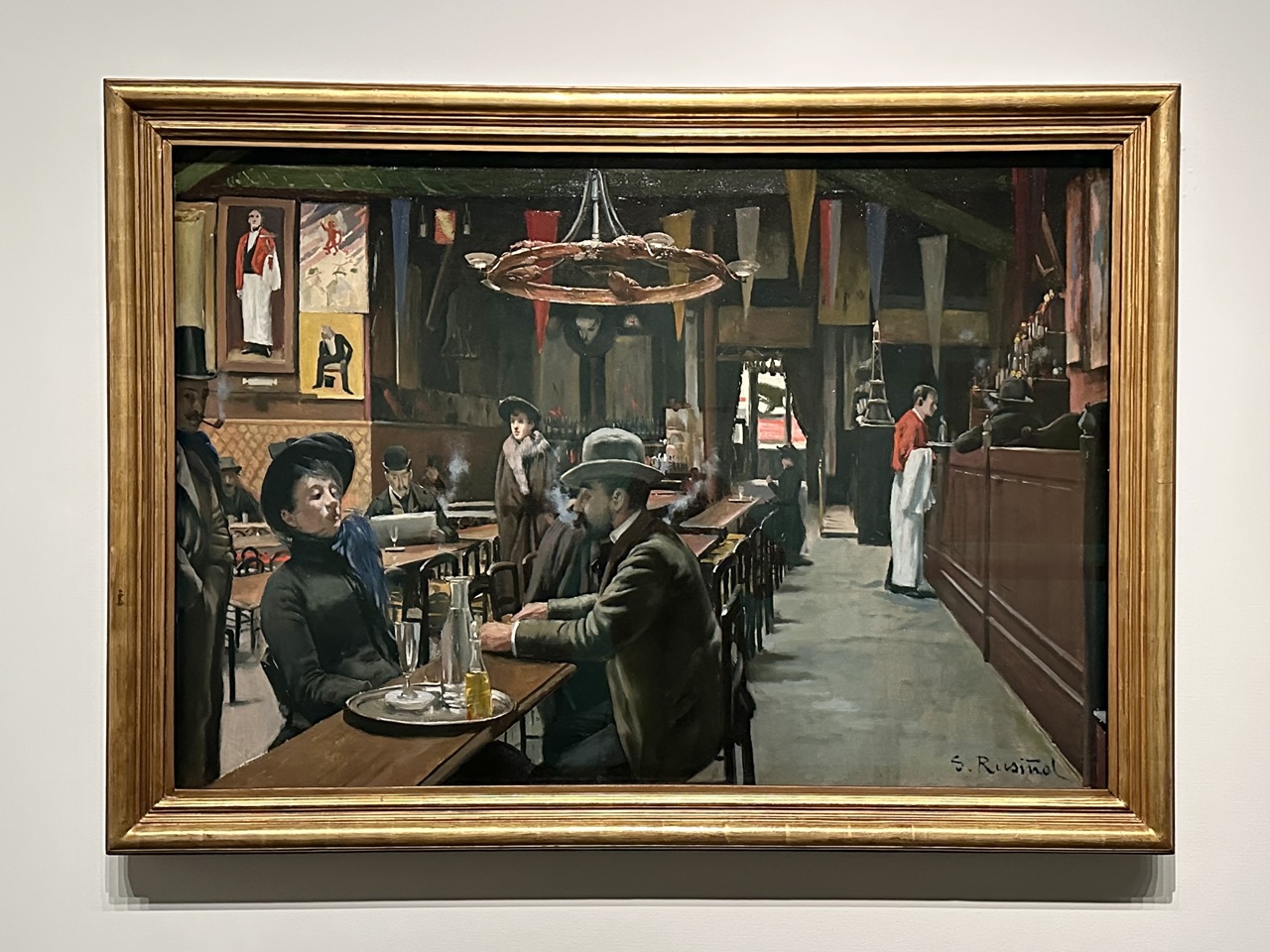
Santiago Rusiñol, *Café des Zancoeran*, 1889-90, Munsalat Museum (donated by J. Sala Ardiz)
While the café of the same name as "Café des Zincoërans," which is being shown in Japan for the first time, actually existed, this film is thought to depict a fictional scene that recreates the atmosphere of a Parisian café that Rusignol frequented.
The composition, which includes portraits of the artist's friends scattered throughout, such as Casas in his bowler hat in the foreground, suggests the existence of a network of Catalan artists in late 19th-century Paris. At the same time, the attitude of creating a work as a playful expression of shared context among friends is in line with the spirit of "uncoéran" (incoherent) art, which satirizes existing authority and academia, and which also gives the work its title.
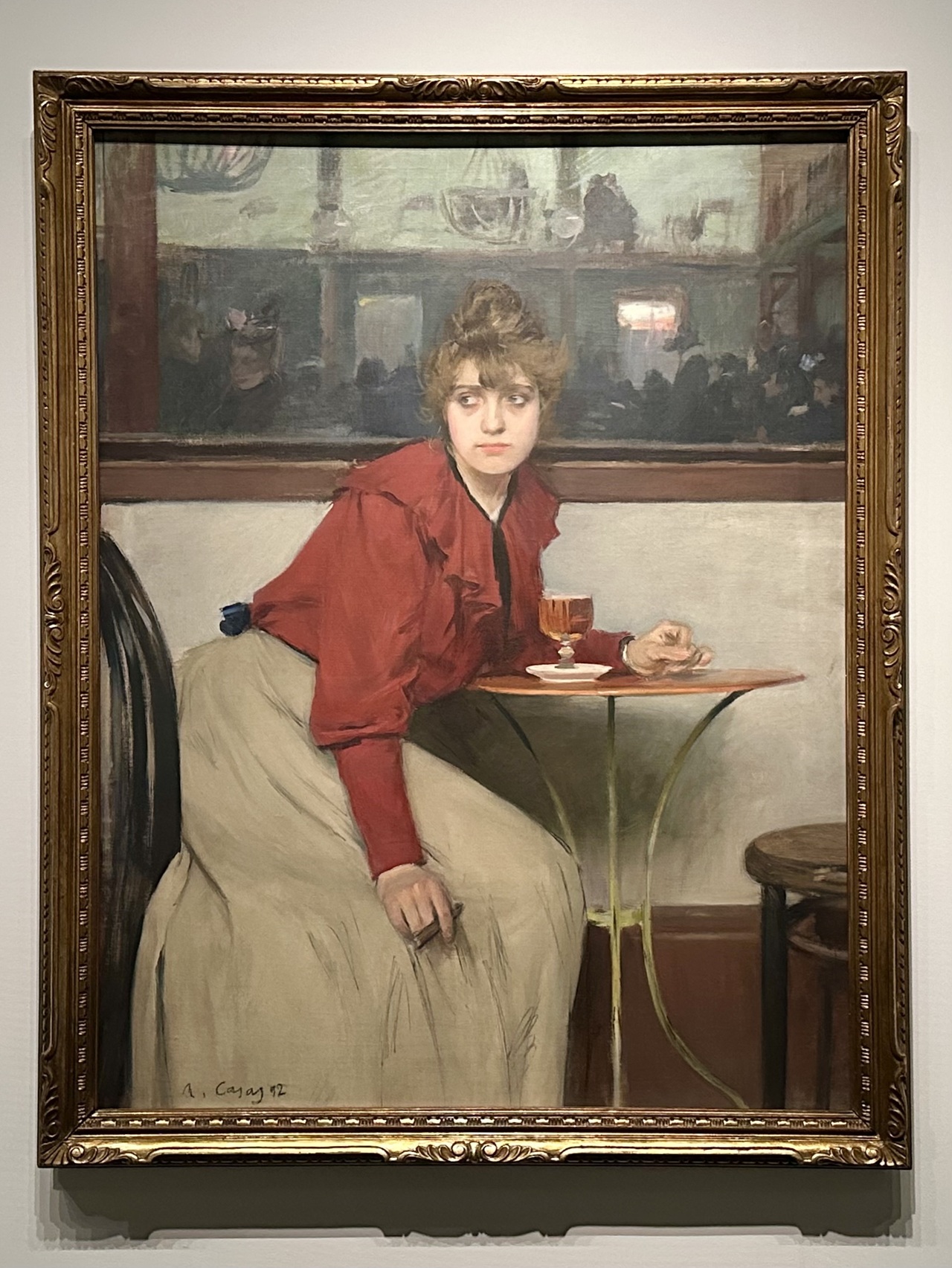
Ramon Casas, *Madeleine*, 1892, Munsalat Museum (donated by J. Sala Ardiz)
On the other hand, "Madeleine" is a masterpiece painted during the period when Casas and Rusignol had a room at the Moulin de la Galette. The woman in the red blouse is a real person named Louise Hortense Boisguiolaume, who frequented the bar.
His feet are pointed to the right of the screen, his upper body is leaning on the table, and although his face is facing forward, his gaze drifts to the left of the screen. This unusual posture creates an effect that circulates the viewer's gaze within the frame. His gestures, as if he is enjoying alcohol and cigarettes while waiting for someone, also bring to light themes that resonate with the sensibilities unique to modern cities: loneliness and alienation in a crowd.
And among the Modernist artists who gathered at Quatre Gatti was a young Pablo Picasso. In 1900, after holding his first solo exhibition at the shop, Picasso moved to Paris, where he was greatly inspired by the night culture of cafes and bars, and by Degas, Renoir, and especially Toulouse-Lautrec. However, the extreme poverty he faced while traveling between the two cities and the profound loss of a close friend's suicide led to a major shift in his artistic style. This led to his "Blue Period," in which he used blue as a dominant color to introspectively depict the melancholy and loneliness of those living in poverty and on the fringes of society.
While we cannot show you any of Picasso's works in this report due to photography restrictions, the exhibition features a juxtaposition of Toulouse-Lautrec's "The Eglantine Men" (1896), which captures the lively French can-can dance, and Picasso's "Can-Can" (1900), which appears to be a reinterpretation of Toulouse-Lautrec's work. Furthermore, works such as "Two Women in a Tavern" (1902), a representative piece from his "Blue Period" far removed from the hustle and bustle of the café, are also on display. The exhibition conveys the journey of the young genius as he built upon the expressions of his predecessors while establishing his own style, so be sure to check it out in person.
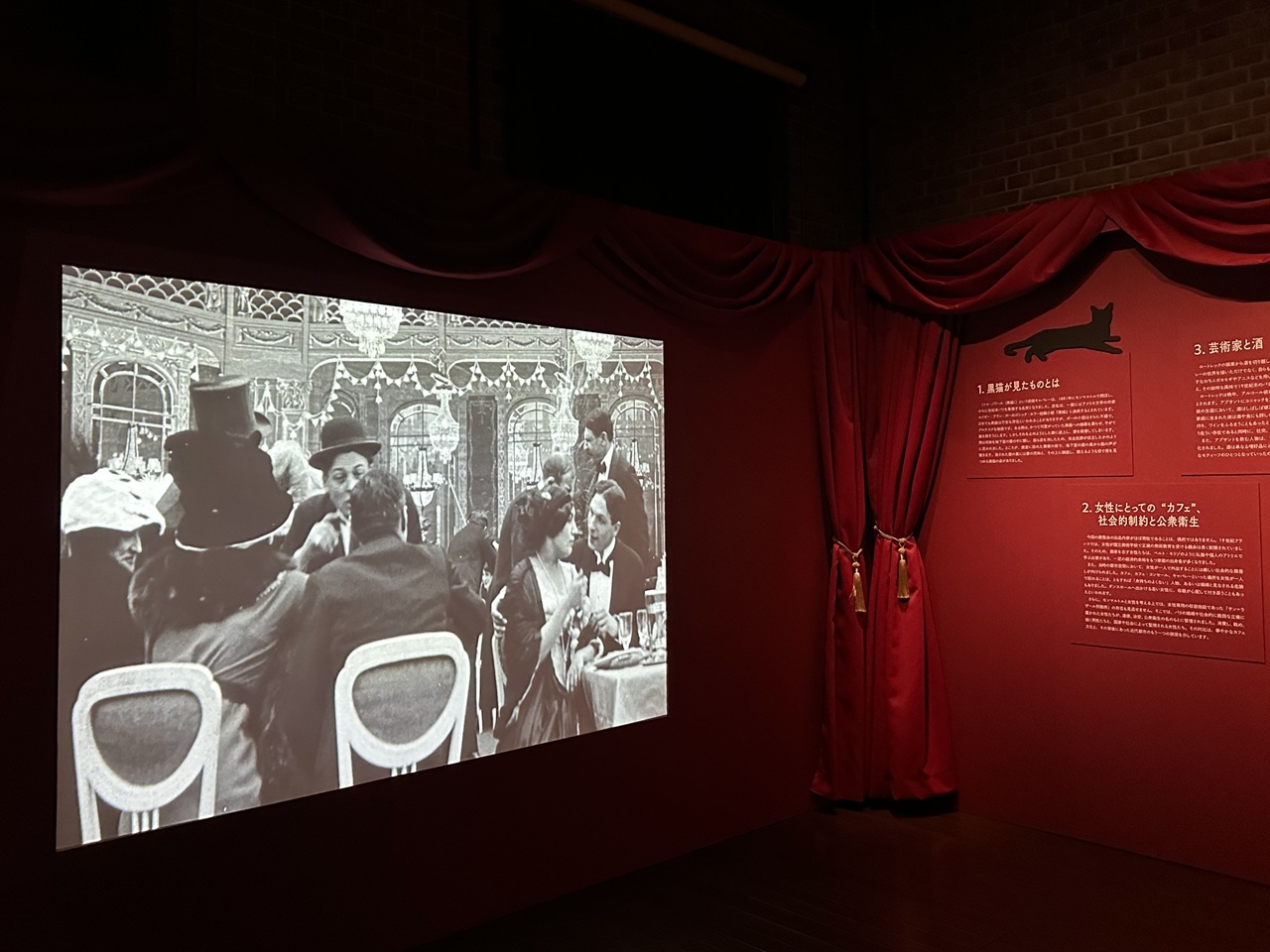
Exhibition photos, video materials
This exhibition is appealing not only for the charm of the artworks themselves, but also for its unique approach of exploring the network of modern art and the dynamism of creativity—topics rarely covered in textbooks—through the lens of "cafes." Furthermore, on evening opening days, from 6 PM to 8 PM, there will be special musical performances in some exhibition rooms, as well as behind-the-scenes stories about cafes geared towards a more mature audience, presented with video materials. Those interested should definitely try visiting in the evening; you'll be able to experience the atmosphere of the entertainment district loved by artists in a much more vivid way.
Summary of "Artists Gathering in 'Cafes'—From Impressionists to Van Gogh, Toulouse-Lautrec, and Picasso"
Date : June 13, 2026 (Saturday) – September 23, 2026 (Wednesday/Holiday)
Venue : Mitsubishi Ichigokan Museum
Opening hours : 10:00 – 18:00
*However, the museum is open until 8 PM on Fridays (excluding public holidays), the second Wednesday of each month, July 25th, and September 19th-23rd.
*Entry is permitted until 30 minutes before closing time.
Closed on Mondays except for national holidays . *However, the museum will be open on Talk Free Days (July 27th and August 31st).
Admission Fees : <Same-day tickets> General admission 2,300 yen, University students 1,300 yen, High school students 1,000 yen, Junior high school students and younger free. *Half price for holders of disability certificates, and one accompanying person free.
* Discounts cannot be used in conjunction with other discounts.
*For further details, please check the exhibition's official website.
Organized by : Mitsubishi Ichigokan Museum, Hiroshima Museum of Art
For inquiries : 050-5541-8600 (Hello Dial)
Official website : https://mimt.jp/ex_sp/cafe/
Domestic Tour : Hiroshima Museum of Art, October 3, 2026 (Sat) – January 11, 2027 (Mon/Holiday)
<Related articles from the past>
Report on the "Winnie the Pooh Exhibition Commemorating the 100th Anniversary of the Original Work's Debut" (Matsuya Ginza) | Visiting Pooh and his friends in the Hundred Acre Wood